What Topical Authority Actually Means
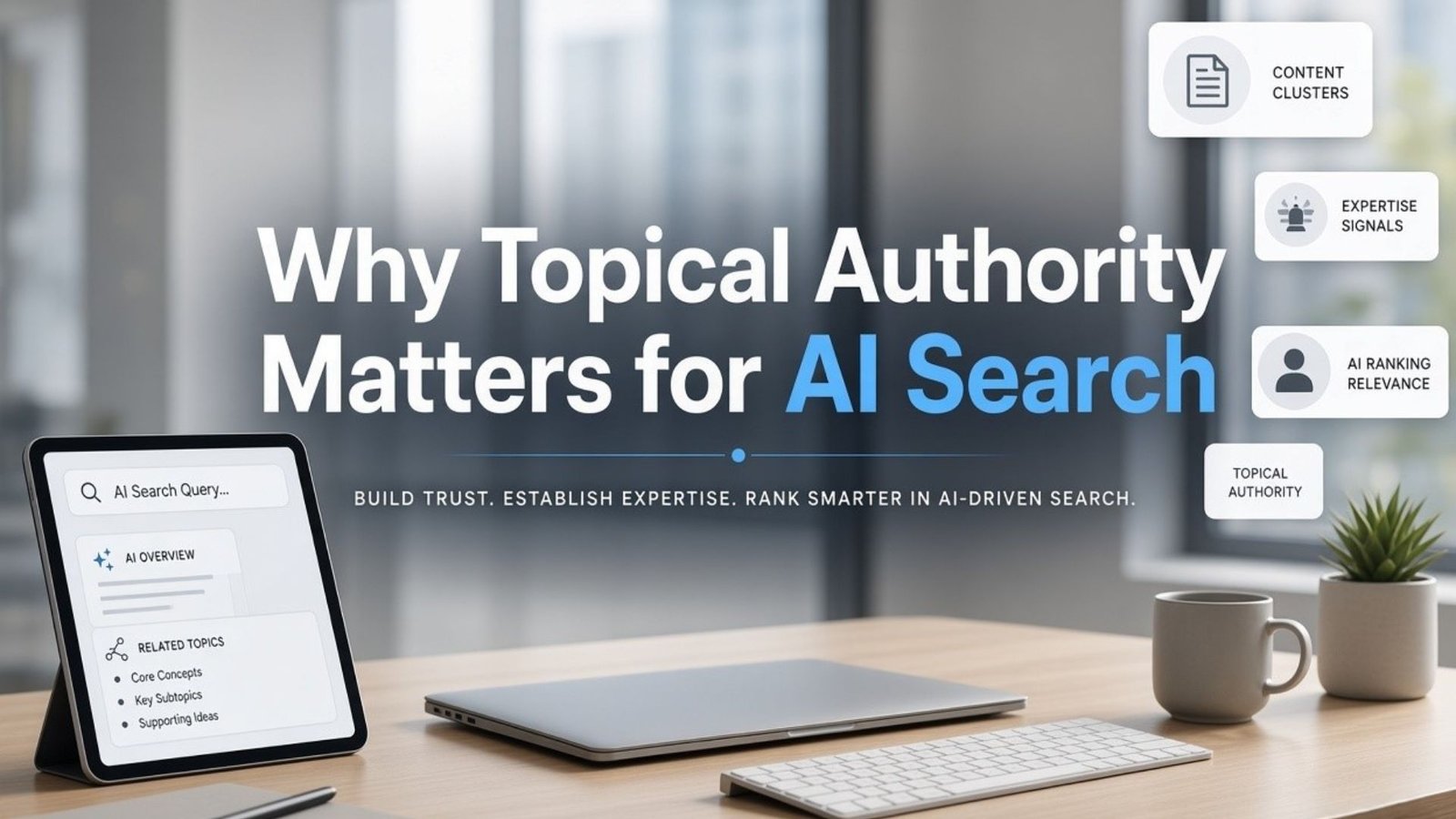
Topical authority is the depth and consistency of expertise a website demonstrates on a specific subject, not just a single page. A site with one great article about “email marketing tips” has a page. A site with dozens of interconnected, well-researched pieces covering email marketing strategy, deliverability, segmentation, automation, and case studies has authority on the topic.
Traditional SEO rewarded this too, but it could be gamed with backlinks and keyword density. AI search systems evaluate content differently and topical authority becomes even more central to how they decide what to trust.
Why AI Search Changes the Calculus
1. AI Answers Are Synthesized, Not Ranked
When an AI system generates an answer, it’s pulling from multiple sources and blending them into a single response. It needs to decide which sources are reliable enough to draw from and cite. A site that has consistently demonstrated deep, accurate coverage of a subject is a safer bet for the model than a single isolated article, even if that article is well-written.
2. Retrieval Favors Depth Over One-Off Pages
Many AI search tools use retrieval-augmented generation, pulling relevant passages from indexed content. A site with a well-structured cluster of related content gives these systems more surface area to retrieve from – and more corroborating context. If five pages on a domain all reinforce the same expertise, that’s a stronger signal than one orphaned page making a similar claim.
3. Trust Signals Are Harder to Fake at Scale
AI systems, like search engines before them, are trying to filter out thin or manipulative content. A domain that has built genuine topical depth over time – through original research, consistent publishing, internal linking, and clear expertise – is much harder to fake than a single optimized page. Authority built over a topic acts as a trust shortcut.
4. Citations Are the New Rankings
In AI Overviews, Perplexity answers, and chat-based search, being cited is the new version of ranking #1. Studies and observed patterns suggest that AI systems disproportionately cite sources that already show up as authoritative across the web on a given topic – sites that other authoritative sources reference, and that consistently appear across multiple related queries, not just one.
👉 Also Read: AI Search Decoded: How ChatGPT & Google AI Cite Content
How to Build Topical Authority for AI Search
- Go deep, not just wide. Instead of scattering content across many unrelated topics, build clusters: a pillar page supported by multiple in-depth subtopic pages, all interlinked.
- Demonstrate real expertise (E-E-A-T). Show experience, expertise, authoritativeness, and trust – author bios, original data, first-hand insights, and citations to credible sources.
- Structure content for extraction. Clear headings, concise answers near the top, well-organized lists and tables – these help both traditional crawlers and AI retrieval systems parse and reuse your content accurately.
- Stay consistent over time. Topical authority isn’t built in a week. Regular, high-quality publishing in the same subject area compounds.
- Earn genuine external validation. Mentions, backlinks, and citations from other authoritative sites in your niche reinforce that you’re a trusted voice on the topic – a signal AI systems weigh heavily.
The Bottom Line
AI search doesn’t reward keyword tricks or one-off viral pages the way old-school SEO sometimes did. It rewards depth, consistency, and demonstrated expertise across a subject – because that’s exactly what makes a source safe to cite and trust. Building topical authority isn’t just good SEO practice anymore; it’s becoming the price of admission for being visible in the AI-driven search landscape at all.
FAQs
Topical authority is the depth and consistency of expertise a website demonstrates on a specific subject, built through interlinked, well-researched content rather than a single standalone page.
AI search tools like ChatGPT, Perplexity, and Google AI Overviews synthesize answers from multiple sources and cite the ones they trust most. Sites with strong topical authority are more likely to be retrieved and cited because they show consistent, verifiable expertise across a subject.
Traditional SEO ranks individual pages in a list of links. AI search generates a single synthesized answer and cites a few sources within it, so being trustworthy and comprehensive on a topic matters more than optimizing one page for one keyword.
No. Backlinks and external mentions still reinforce authority – they signal to both search engines and AI systems that other credible sources recognize your expertise on a topic.
It varies, but it’s a long-term effort. Consistent publishing, content clustering, and earning genuine external validation over months (not days) is typically what builds durable authority.
E-E-A-T stands for Experience, Expertise, Authoritativeness, and Trust. It’s a framework for demonstrating credibility, and it directly supports topical authority – the more clearly your content shows real E-E-A-T, the more AI systems and search engines trust it.
It’s harder for new sites, since authority is built on a track record. Focused, high-quality content clusters around a specific niche (rather than broad, scattered topics) is the fastest realistic path.