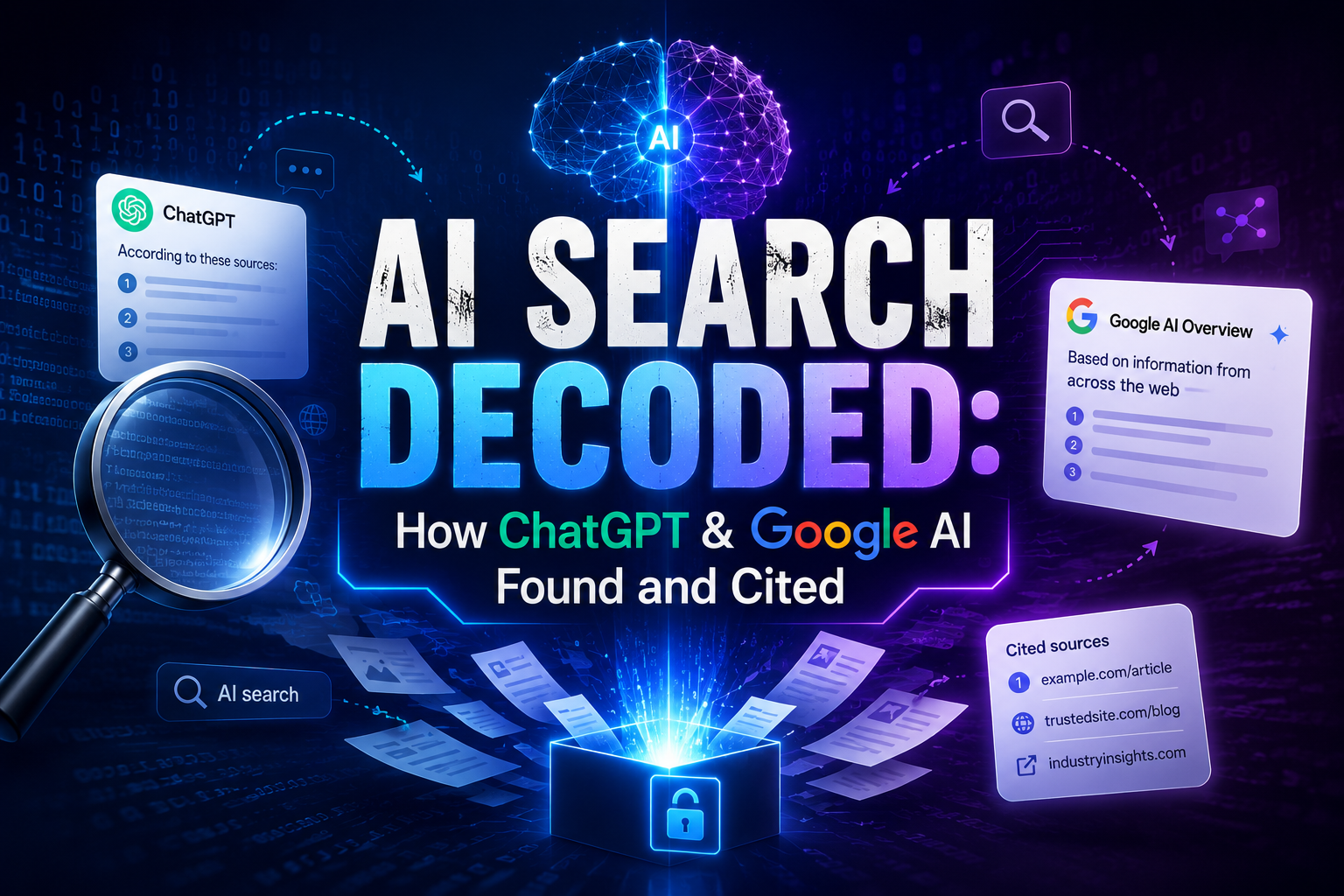
Search used to mean typing a query and scrolling through a list of blue links. Today, more searches end with a single AI-generated answer—and your content either gets discovered, referenced, and cited, or remains invisible to the user.
This guide breaks down, in simple terms, how AI search engines find, evaluate, select, and cite content. More importantly, we’ll explore why there’s no one-size-fits-all approach.
ChatGPT, Perplexity, Google AI Overviews, and Claude don’t all discover and cite content in the same way. A strategy that helps your content get cited by one platform may have little impact on another.
If you want your content to be visible in AI-generated answers, understanding these differences is the first step.
The Big Shift: AI Ranks Answers, Not Just Pages
Traditional search engines primarily evaluate and rank web pages. If your page ranks #3 or #10, the entire page earns that position in the search results.
AI search works differently. Instead of treating a page as one complete unit, AI systems can identify specific passages, sections, or individual answers that best match a user’s query. A single well-written paragraph may be selected and cited – even if the page itself doesn’t rank highly for the traditional search query.
In simple terms: AI search rewards content that provides clear, specific, and information-rich answers. A page doesn’t always need to be the strongest overall authority to get noticed. One highly relevant section that directly answers a question can be enough to earn visibility.
That’s a major shift in how content visibility works – and it changes how we should structure content for AI search.
How AI Actually Finds and Cites Your Content (RAG, Explained Simply)
Many AI-powered answers that include citations rely on a process called Retrieval-Augmented Generation (RAG). The name sounds technical, but the concept is straightforward.
Instead of relying only on information learned during training, an AI system can retrieve relevant information from external sources, evaluate it, and use the most useful pieces to generate an answer.
Here’s roughly what happens behind the scenes:
- Your content is broken into smaller chunks – such as paragraphs, sections, or passages – and converted into a format that can be compared with search queries.
- Those content chunks are stored in a searchable index, allowing the system to retrieve relevant information quickly.
- When someone asks a question, the AI turns that question into the same kind of searchable format.
- The system searches for relevant content, focusing on meaning and context rather than simply matching exact keywords.
- The most relevant sources or passages are selected based on factors such as relevance, quality, and other retrieval signals.
- It feeds those chunks into the answer it generates, and credits them as sources.
The key takeaway: the AI isn’t remembering your page from months ago. It’s checking the web (or its search index) right now, matching meaning rather than exact wording, and only using the small pieces that are genuinely relevant.
A few practical effects of this:
- Because AI tools check many sources for a single question – often far more than a person would ever click through – you’re competing against a much wider field than a normal Google results page.
- AI systems don’t like guessing. Looking things up in real time helps them avoid making up facts, avoid relying on outdated information, and actually name their sources.
- AI tools sometimes read a cached, older version of your page rather than the live one. So an update you made today might not show up in an AI answer for a while.
What Actually Gets Content Ranked and Cited
Pulling together current research and observed platform behavior, these five things consistently matter:
1. Meaning Matters More Than Keywords
AI tools try to understand what a question is really asking, not just match words. Keyword stuffing won’t help – writing a clear, direct answer to the actual question will.
2. Content Needs to Be Easy to “Chunk”
If a section of your page jumps between unrelated ideas, it’s harder for AI to pull out a clean answer. Content that stays focused – one clear idea per section, under a clear heading – is much easier for AI to lift and use correctly.
3. Trust Signals Still Count
AI tools favor sources that show real expertise: clear author information, direct answers, credible sourcing, and structured data (schema markup) that helps machines understand who’s behind the content and why it should be trusted.
4. Freshness Genuinely Helps
Updating a page – even in small ways – appears to reset how “fresh” it looks to these systems. Adding a visible “last updated” date and refreshing your stats regularly (at least yearly) is a simple, low-effort win. On Perplexity specifically, showing a current-year date on your content appears to meaningfully boost citation odds.
5. The AI Has to Be Able to Reach Your Content First
None of the above matters if the AI’s crawler can’t access your page. If you’re missing from an AI answer, the cause could be blocked crawling, poor site structure, a weak match in meaning, low trust signals, or simply a competing page doing it better. Without checking each platform separately, it’s hard to know which one is the actual problem.
AI Search Works Differently on Every Platform
This is the part most guides gloss over, and it’s arguably the most useful thing to understand. ChatGPT, Perplexity, and Google AI Overviews each pull from different sources and behave in different ways. Getting cited on one doesn’t mean you’ll show up on another.
Large-scale citation studies back this up clearly: across hundreds of millions of citations, only about 1 in 10 domains get cited by both ChatGPT and Perplexity. ChatGPT leans heavily on Wikipedia and other encyclopedia-style content for roughly half its top citations. Perplexity leans just as heavily on Reddit. Google AI Overviews, by contrast, pulls more from YouTube and other multimedia content.
Even Google’s own tools don’t agree with each other – AI Overviews and Google’s separate AI Mode cite the exact same page only around 1 in 7 times, even when they land on a similar answer.
The gap gets even bigger when you zoom in on individual brands. One analysis found that citation volume for the same brand could swing by several hundred times depending on the platform – a brand that dominates on Perplexity can be almost invisible on ChatGPT, and the other way around.
Here's a simple breakdown of how the major platforms differ:
ChatGPT
ChatGPT often answers using what it already learned during training, rather than actively searching the web for every question. That means your visibility here depends a lot on whether your content was widely referenced or well-known at the time the model was trained – which ties back to overall brand strength and authority, not just page-level tweaks. Studies also show ChatGPT tends to name specific brands less often than other AI tools, making it the hardest platform for direct brand visibility.
Perplexity
Perplexity behaves more like a true search engine layered with AI. It actively searches the web for nearly every question and shows its sources clearly and consistently – every answer includes visible, numbered citations by default. It tends to favor content with real data, named sources, clear methodology, and recent updates. Because citations are so visible and clickable, traffic from Perplexity tends to convert noticeably better than traffic from traditional search.
Google AI Overviews / AI Mode
These appear automatically for certain searches, based on the type of query and what Google thinks the user needs. The reassuring part: the vast majority of AI Overview citations go to pages that already rank well in regular Google search. So if your traditional SEO is solid, you already have a strong foundation here.
Claude AI
In studies tracking brand citations across major AI platforms over several months, Claude gave brands a notably higher share of citation credit compared to the others – making it a platform worth paying attention to, even though it gets less discussion than ChatGPT or Perplexity.
Small Sites Can Compete Here — With a Catch
One encouraging finding: raw domain authority matters less in AI search than it does in traditional SEO. Newer or smaller websites have a real shot, because these systems tend to prioritize relevance and clarity over how “big” or established a site is. In fact, AI tools frequently cite pages that don’t even appear on the first page of Google.
The catch is that “small” doesn’t mean “thin.” Sites still need genuinely thorough content on their core topics, plus solid technical basics – fast load times and a well-performing site overall.
There’s also a bigger-picture factor worth knowing: getting mentioned consistently across other trusted websites – not just publishing on your own site – appears to meaningfully boost how often AI tools cite you. Think of it as the AI-era version of link building: it’s not just about what you publish, it’s about how often your name comes up elsewhere too.
Quick Comparison: Traditional Search vs. AI Search
Factor | Traditional Search | AI Search |
What gets ranked | The whole page | A specific paragraph or section |
Main ranking signal | Backlinks, keyword usage | Clear meaning, information density |
Trust signal | Domain authority | Expertise, credentials, structured data |
Impact of freshness | Moderate | High – can directly affect whether you get picked |
Chance for small sites | Limited without backlinks | Real – clarity can beat size |
Consistency across engines | Fairly similar everywhere | Very different from platform to platform |
A Simple Checklist to Get AI-Citation Ready
- Test each section on its own. Could someone understand your point from just one paragraph, without reading the rest of the page?
- Show your content is current. Add a visible “last updated” date and refresh key facts and numbers at least once a year.
- Build real trust signals. Include author bios, clear sourcing, and basic schema markup so machines can tell who’s behind the content.
- Check platforms separately, not as one group. If you’re missing from ChatGPT but doing fine on Perplexity, that’s two different problems needing two different fixes.
- Get mentioned elsewhere, not just on your own site. Coverage, guest content, and mentions from other trusted sources add up.
- Keep your traditional SEO strong. Since Google AI Overviews leans so heavily on already well-ranked pages, solid core SEO still pays off directly.
Key Takeaways
- AI search tools rank small pieces of content, not whole pages – clear, focused writing at the paragraph level really matters.
- The technology behind most AI citations, RAG, works by searching your content in real time and matching it to a question by meaning, not exact keywords.
- ChatGPT, Perplexity, Google AI Overviews, and Claude each behave differently – a strategy built for one won’t automatically work on the others.
- Smaller or newer sites genuinely have a shot at getting cited, as long as the content is clear, well-structured, and genuinely thorough.
- Freshness, credibility signals, and mentions from other sites all measurably affect whether you get cited – and none of these are “set it and forget it” fixes.
Treating each AI platform as its own audience, rather than lumping them all into one generic strategy, is what actually moves the needle as AI search keeps growing.
FAQs
Citing means an AI tool like ChatGPT or Perplexity pulls specific information from a webpage and credits that page as the source of its answer, rather than just linking to it in a list of results.
Each platform retrieves and evaluates content differently. ChatGPT often relies on encyclopedic sources like Wikipedia, Perplexity leans heavily on community platforms like Reddit, and Google AI Overviews tend to favor pages that already rank well in traditional search.
RAG (Retrieval-Augmented Generation) is the process AI tools use to search the web in real time, pull relevant content, and generate an answer based on what they find – rather than relying only on what they learned during training. It’s the main reason AI tools can cite current, specific sources.
Not always. Google AI Overviews tend to favor pages that already rank well in traditional search, but tools like ChatGPT and Perplexity often cite pages that don’t appear in Google’s top 10 results at all.
Yes. AI search tools tend to prioritize clear, relevant, well-structured content over domain age or authority, giving smaller sites a real opportunity to get cited – as long as the content is genuinely thorough and well-organized.
There’s no fixed rule, but refreshing key facts and statistics at least once a year, along with a visible “last updated” date, appears to improve how likely content is to be picked up and cited.
No. Because ChatGPT, Perplexity, and Google AI Overviews use different sourcing methods, a strategy that works well on one platform may have little to no effect on another.