Imagine you’re looking for the best digital marketing agency, a reliable plumber, or a nearby restaurant. A few years ago, you would have opened Google, typed a few keywords, and browsed through multiple websites before making a decision.
Today, many people simply ask ChatGPT, Gemini, Claude, or Perplexity AI questions like:
- “What’s the best digital marketing agency for a startup?”
- “Recommend a web design company near me.”
- “Which SEO agency has experience with local businesses?”
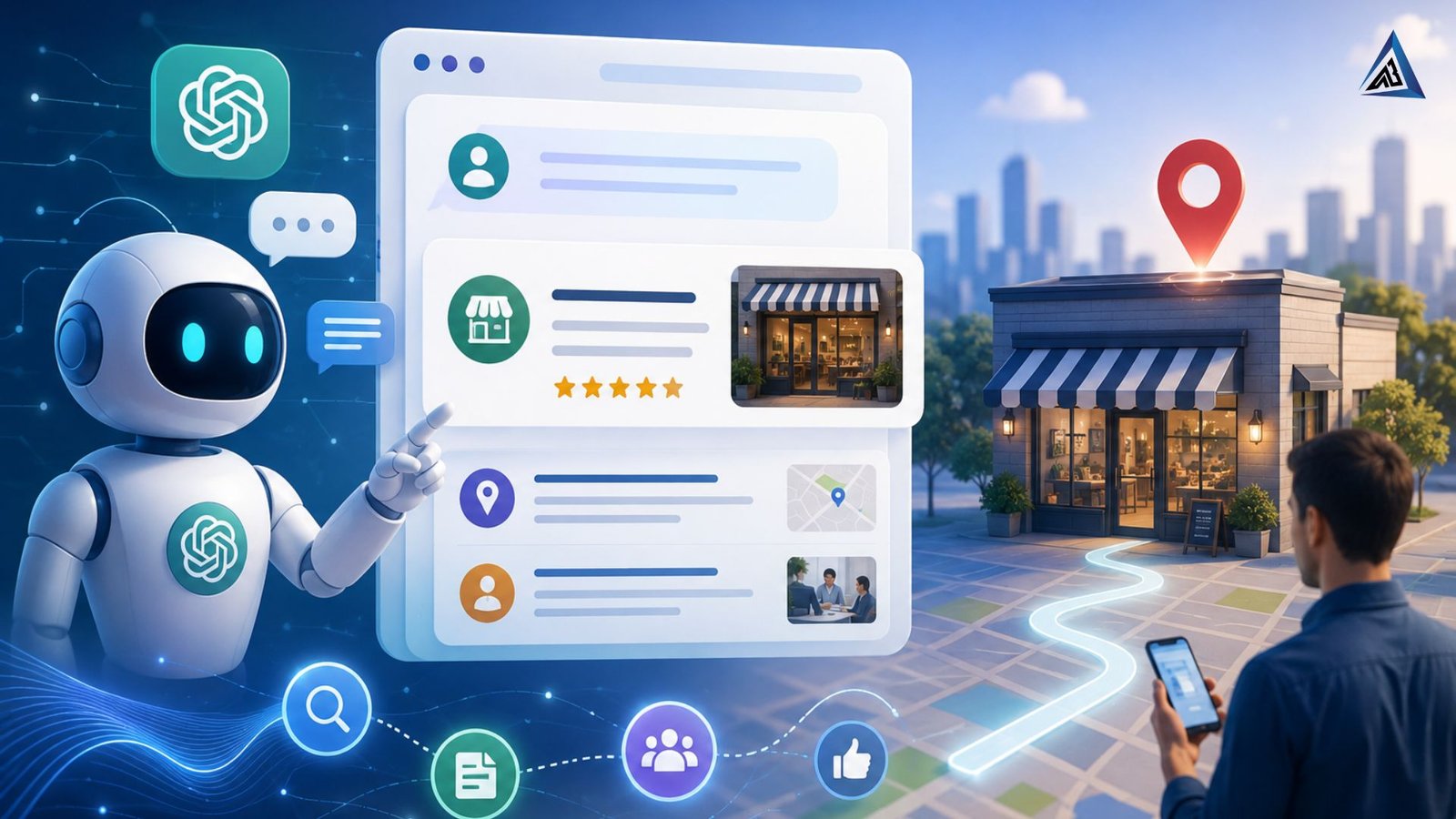
Instead of showing a list of links, these AI assistants provide direct, conversational answers. This shift is changing how people discover businesses, compare services, and make purchasing decisions.
For business owners, marketers, and website managers, this means traditional Search Engine Optimization (SEO) alone is no longer enough. Businesses must now optimize for AI-powered search, conversational search, and natural language queries to remain visible where modern customers are searching.
This new era has introduced concepts such as Generative Engine Optimization (GEO) and Answer Engine Optimization (AEO), which focus on helping AI systems understand, trust, and recommend your business.
In this guide, you’ll learn how ChatGPT is changing the way customers find businesses, why AI search matters, and the practical steps you can take to improve your online visibility in both traditional search engines and AI-generated answers.
Table of Contents
What Is AI Search?
Artificial Intelligence has changed nearly every aspect of digital marketing, and search is one of the biggest transformations.
AI search uses large language models (LLMs), machine learning, and advanced natural language processing to understand what users actually mean – not just the keywords they type.
Instead of matching exact keywords, AI analyzes:
- Search intent
- User context
- Natural language queries
- Conversation history (where available)
- Content relevance
- Brand authority
- Trust signals
- Website credibility
For example, if someone asks:
👉 “Which company can help my local business generate more leads online?”
A traditional search engine may display thousands of pages based on matching keywords.
An AI assistant, however, attempts to understand the user’s intent and may recommend businesses that demonstrate expertise in Local SEO, website optimization, lead generation, and digital marketing – even if the exact wording doesn’t appear on the page.
This is why businesses now need to create content that answers real questions instead of simply targeting individual keywords.
Why AI Search Is Different from Traditional Search
Traditional search engines primarily rank web pages and let users choose which result to open.
AI-powered search works differently.
Instead of presenting ten blue links, AI assistants analyze information from multiple trusted sources and generate a direct response.
This creates a faster and more personalized search experience, allowing users to receive recommendations without visiting numerous websites.
Some key characteristics of AI search include:
- Conversational responses
- Context-aware recommendations
- Better understanding of user intent
- AI-generated answers
- Personalized information
- Faster decision-making
As AI continues to improve, customers are spending less time searching and more time acting on the recommendations they receive.
This growing trend is also contributing to the rise of zero-click search, where users get the information they need without clicking through multiple search results.
How ChatGPT Finds Information
One of the biggest misconceptions is that ChatGPT simply searches Google and repeats the results.
In reality, modern AI systems use a combination of:
- Large language models
- Structured information
- Trusted online sources
- Publicly available knowledge
- High-quality websites
- Business profiles
- Knowledge graphs
- Citations and authoritative references
When ChatGPT has access to current web information, it evaluates the credibility, relevance, and usefulness of available content before generating a response.
This means businesses with clear, well-structured, and authoritative websites are more likely to be referenced than websites with thin, outdated, or poorly organized content.
AI also prefers content that demonstrates:
- Expertise
- Experience
- Authority
- Trustworthiness
- Accurate information
- Helpful explanations
- Clear structure
- Consistent branding
This is why creating high-quality content is becoming one of the most valuable investments for businesses that want long-term visibility.
Why Customer Search Behavior Is Changing
Consumer expectations have changed dramatically over the last few years.
People no longer want to spend 20 minutes comparing websites before making a decision.
They expect instant, personalized, and trustworthy answers.
Instead of searching:
 “Best SEO company India”
Many users now ask:
- “Which SEO agency is best for small businesses?”
- “Who offers affordable local SEO services?”
- “Can you recommend a digital marketing agency with good results?”
- “Which company specializes in AI Search Optimization?”
These conversational questions reveal much deeper search intent than traditional keyword searches.
Customers are no longer searching for websites – they’re searching for solutions.
This shift means businesses must create content that directly addresses customer problems, answers specific questions, and demonstrates genuine expertise.
Companies that invest in topical authority, entity SEO, structured data, schema markup, brand authority, and trust signals will be better positioned to appear in AI-generated recommendations.
In the coming years, businesses that adapt to AI-powered search will gain a significant competitive advantage, while those relying solely on traditional SEO tactics may struggle to maintain their visibility.
Google Search vs. ChatGPT Search
Although both Google Search and ChatGPT help users find information, they work in very different ways.
Google Search | ChatGPT Search |
Returns a list of websites | Provides direct, conversational answers |
Users compare multiple pages | AI summarizes relevant information |
Heavy focus on keywords and backlinks | Strong focus on context, relevance, and authority |
Encourages users to click links | Often answers questions immediately |
Ranking depends on traditional SEO factors | Recommendations depend on content quality, trust, and topical expertise |
Traditional SEO is still important because search engines remain a major source of traffic. However, businesses that ignore AI-powered search risk missing a growing audience that prefers conversational experiences.
The future isn’t Google vs. ChatGPT – it’s businesses optimizing for both.
Why Traditional SEO Alone Is No Longer Enough
For years, many businesses focused on ranking for a few high-volume keywords. While this strategy still has value, it doesn’t fully address how AI assistants understand and recommend content.
Modern AI systems evaluate much more than keyword placement. They consider factors such as:
- Whether your content genuinely answers user questions.
- How well your website demonstrates expertise.
- Whether your brand is mentioned across trusted sources.
- The clarity and structure of your content.
- Overall topical authority.
- User experience and website performance.
- Trust signals such as reviews, author information, and business credibility.
Simply repeating keywords is no longer enough. AI prefers content that is comprehensive, easy to understand, and genuinely helpful.
For example, an article titled “SEO Services“ with only a few hundred words may rank for some keywords, but a detailed guide explaining SEO strategies, technical optimization, Local SEO, AI Search Optimization, and real-world examples is far more likely to be considered valuable by both search engines and AI assistants.
What Makes AI Recommend One Business Over Another?
Imagine two companies offering the same service.
Business A | Business B |
Thin service pages | Detailed, helpful content |
Generic content | Clear explanations for customers |
No FAQs | FAQ sections answering real questions |
No author information | Proper Schema Markup |
No structured data | Strong Local SEO |
Few online mentions | Positive customer reviews |
Inconsistent branding | Consistent brand messaging |
– | Regularly updated website |
– | Educational blog articles |
Which business is more likely to be recommended by AI?
The answer is almost always Business B.
AI systems aim to provide users with the most useful and trustworthy information available. Businesses that consistently publish high-quality content build stronger brand authority, content authority, and trust signals, making them more likely to appear in AI-generated answers.
The Rise of Conversational Search
Search queries are becoming more natural.
Instead of typing:
“SEO company Mohali”
Users now ask:
“Can you recommend an SEO company in Mohali that helps small businesses grow online?”
This is known as conversational search, and it reflects how people naturally speak.
Because AI understands natural language, businesses need to create content that mirrors real customer questions rather than focusing only on short keywords.
Adding sections such as:
- Frequently Asked Questions
- Step-by-step guides
- Comparison articles
- Industry-specific solutions
- Case studies
- How-to content
helps AI understand that your website provides complete answers, improving its chances of being referenced.
AI Recommendations Influence Buying Decisions
AI assistants are becoming trusted advisors.
Before contacting a business, customers increasingly ask questions like:
- Is this company reliable?
- Which option offers the best value?
- Who has experience in my industry?
- What are the advantages of choosing this service?
Businesses that provide transparent pricing, showcase customer success stories, publish educational resources, and maintain accurate business information build stronger credibility.
These trust signals help AI systems feel more confident recommending a business.
This means your website is no longer just a marketing tool – it becomes a knowledge resource that demonstrates expertise and supports informed decision-making.
Why Topical Authority Matters More Than Ever
Publishing one blog on a topic is rarely enough.
AI systems look for patterns that indicate genuine expertise.
For example, if your business offers digital marketing services, your website should include in-depth content on related subjects such as:
- Search Engine Optimization (SEO)
- AI Search Optimization
- Local SEO
- Technical SEO
- Website Design
- Content Marketing
- Pay-Per-Click (PPC)
- Social Media Marketing
- Conversion Rate Optimization (CRO)
- Online Reputation Management
When these topics are connected through internal links and consistently updated, your website builds topical authority. This helps both search engines and AI assistants recognize your business as a trusted source within your industry.
Rather than creating isolated articles, focus on developing a content ecosystem where each page supports the others and answers a different stage of the customer’s journey.
Key Takeaways
The way customers discover businesses is evolving rapidly.
Success is no longer determined solely by ranking #1 on Google. Businesses must also earn the trust of AI systems by publishing accurate, authoritative, and genuinely helpful content.
The companies that invest in AI Search Optimization, Generative Engine Optimization (GEO), Answer Engine Optimization (AEO), and high-quality educational content today will be better positioned to attract customers tomorrow.
Frequently Asked Questions
ChatGPT is changing the way customers find businesses by providing direct, conversational answers instead of a list of search results. Users can ask detailed questions, such as finding the best local service provider or comparing businesses, and receive personalized recommendations based on relevant, trustworthy, and high-quality information.
Yes, ChatGPT can reference or recommend businesses when they have a strong online presence, authoritative content, consistent business information, positive trust signals, and content that clearly answers user questions. While there is no guaranteed ranking, improving your website’s quality and authority increases your chances of being mentioned.
AI Search Optimization is the process of improving your website and content so AI-powered search tools like ChatGPT, Google AI Overviews, Gemini, Claude, and Perplexity can better understand, trust, and reference your business in their responses. It combines traditional SEO with strategies such as high-quality content, structured data, and topical authority.
Absolutely. Traditional SEO remains the foundation of online visibility. However, businesses should also focus on AI Search Optimization, Generative Engine Optimization (GEO), and Answer Engine Optimization (AEO) to increase their visibility in conversational AI platforms and AI-generated search results.
Generative Engine Optimization (GEO) is the practice of creating and optimizing content so generative AI platforms can easily understand and use it when answering user questions. GEO focuses on content quality, authority, relevance, structured information, and answering real customer queries.
Answer Engine Optimization (AEO) helps your content become the best possible answer to user questions. It involves writing clear, well-structured content, using headings, FAQs, schema markup, and concise explanations that search engines and AI assistants can easily interpret.
Yes. Schema markup helps search engines understand your website’s content more clearly. While it doesn’t guarantee that AI assistants will reference your business, it improves content clarity, supports rich search results, and strengthens your overall SEO strategy.
Topical authority shows that your website has deep expertise in a specific subject. By publishing comprehensive content around related topics and connecting them through internal links, you increase your credibility with both search engines and AI systems, making your business more likely to be recommended.
Trust signals are elements that demonstrate your business is reliable and credible. Examples include customer reviews, testimonials, author profiles, business certifications, secure HTTPS, transparent contact information, and consistent branding. AI systems often consider these signals when evaluating the quality and reliability of online content.
Businesses should invest in high-quality content, AI Search Optimization, technical SEO, Local SEO, Entity SEO, structured data, and user experience. Building brand authority and consistently answering customer questions will help businesses remain competitive as AI-powered search continues to evolve.