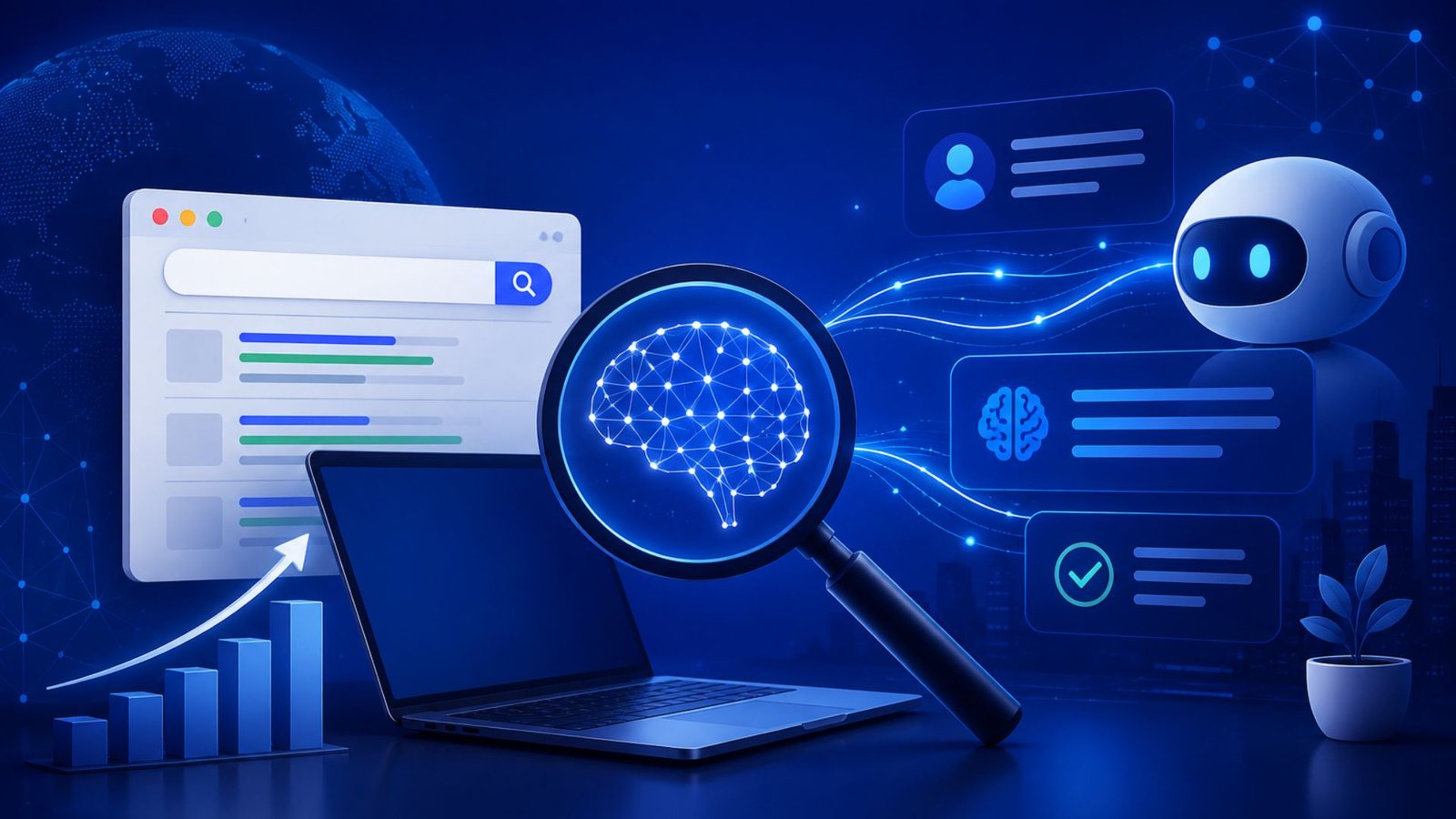
For years, businesses have focused almost entirely on ranking higher in Google. While Google remains one of the most important traffic sources, the way people search for information is changing rapidly.
Today, millions of users ask questions directly to AI-powered platforms instead of typing keywords into a traditional search engine. Instead of browsing through multiple websites, they expect instant, conversational answers from tools like ChatGPT and other AI search experiences.
This shift means businesses need to think beyond traditional SEO. If your website is only optimized for Google rankings, you could miss opportunities to appear in AI-generated answers where customers are increasingly discovering products, services, and brands.
This is where AI Search Optimization becomes essential.
Table of Contents
The Evolution of Search
Search has changed dramatically over the past two decades.
Yesterday
Users searched like this:
They clicked several websites before making a decision.
Today
Users ask complete questions such as:
- Which digital marketing agency is best for small businesses?
- Who offers affordable SEO services with proven results?
- What company should I hire for website development?
Instead of displaying only links, AI platforms generate direct answers by analyzing information from multiple trusted sources.
This new search behavior is changing how businesses earn visibility online.
What Is AI Search Optimization?
AI Search Optimization is the process of improving your website, content, and online presence so AI-powered search platforms can understand, trust, and recommend your business in their responses.
Unlike traditional SEO, which focuses primarily on ranking webpages, AI Search Optimization focuses on making your business a reliable source of information.
The goal is not simply to appear in search results but to become part of the answer.
Google Search vs AI Search
Although they share similarities, traditional search engines and AI search work differently.
Google Search | AI Search |
Shows a list of webpages | Generates direct answers |
Relies heavily on rankings | Relies on understanding context |
Users compare multiple websites | Users often receive one summarized response |
Keywords play a major role | Meaning and relevance matter more |
Clicks are the primary goal | Trustworthy answers are the priority |
Businesses that understand this difference will have a significant advantage in the coming years.
Why AI Search Matters for Businesses
Customers Are Changing Their Search Habits
People now expect quick, accurate answers instead of spending time visiting multiple websites.
Businesses that optimize for AI search have a better chance of being recommended during these conversations.
Visibility Is No Longer Limited to Google
Your customers may discover your business through AI assistants, voice search, smart devices, and other AI-powered search platforms.
Optimizing only for Google means ignoring a growing number of potential customers.
AI Rewards Trust and Authority
AI systems evaluate information differently.
Instead of focusing only on keywords, they also consider factors such as:
- Expertise
- Content quality
- Brand authority
- Topical depth
- Consistency
- Reliable information
Businesses that consistently publish helpful content are more likely to be referenced.
Brand Mentions Are Becoming More Valuable
Even when people don’t click a website, seeing your business recommended by AI builds credibility.
Frequent brand mentions increase awareness and customer trust.
Signs Your Website Is Not Ready for AI Search
Your business may struggle in AI-powered search if:
- Your content only targets keywords instead of answering real questions.
- Your website lacks clear service information.
- You publish thin or repetitive articles.
- Your pages don’t demonstrate expertise.
- You don’t use structured data.
- Your business has little online authority.
- Your content isn’t updated regularly.
How AI Understands Your Website
AI doesn’t simply scan keywords.
It tries to understand:
- What your business does
- Who your services help
- Which industries you specialize in
- Whether your information is trustworthy
- How your content connects across your website
- Whether other reputable sources mention your brand
The clearer your website communicates these signals, the easier it becomes for AI to understand your business.
How to Optimize Your Website for AI Search
Create Helpful Content
Focus on solving real customer problems instead of writing only for search engines.
Answer common questions thoroughly and naturally.
Build Topical Authority
Rather than publishing unrelated articles, create content clusters around your core services.
For example, a digital marketing agency could cover:
Comprehensive coverage demonstrates expertise.
Improve Content Quality
AI prefers content that is:
- Accurate
- Detailed
- Easy to understand
- Well-structured
- Up to date
Avoid keyword stuffing and prioritize genuine value.
Use Structured Data
Schema Markup helps search engines and AI systems better understand your content.
It can provide additional context about:
- Services
- FAQs
- Reviews
- Organizations
- Articles
- Authors
Strengthen Your Brand
AI often recognizes businesses that have a consistent online presence.
Improve your brand visibility by:
- Publishing expert articles
- Earning quality backlinks
- Encouraging customer reviews
- Being active on relevant platforms
- Maintaining consistent business information
Focus on User Experience
A fast, secure, and mobile-friendly website supports both users and search systems.
Key improvements include:
- Faster page speed
- Clear navigation
- Helpful internal links
- Easy-to-read layouts
- Accessible design
Common AI Search Optimization Mistakes
Many businesses make avoidable mistakes, including:
- Writing only for search engines
- Publishing duplicate content
- Ignoring user intent
- Using outdated information
- Neglecting technical SEO
- Failing to build authority
- Producing content without real expertise
Avoiding these issues helps improve long-term visibility.
The Future of SEO Is AI-Ready
Traditional SEO is not disappearing. Instead, it is evolving.
Businesses that combine SEO, AI Search Optimization, Generative Engine Optimization (GEO), and Answer Engine Optimization (AEO) will be better positioned to reach customers across both search engines and AI-powered platforms.
The future belongs to brands that create useful, trustworthy, and comprehensive content – not just content designed to rank for keywords.
Final Thoughts
Google remains an essential part of every digital marketing strategy, but it is no longer the only place where customers search for information.
As AI-powered search continues to grow, businesses that adapt early will gain a competitive advantage. By investing in AI Search Optimization, publishing authoritative content, and building a trustworthy online presence, your business can stay visible wherever your audience looks for answers.
The goal is no longer just to rank – it is to become the source that AI and users trust.
FAQs About AI Search
AI Search Optimization is the process of improving your website and content so AI-powered search tools can understand, trust, and recommend your business in their responses. It focuses on creating high-quality, authoritative, and well-structured content rather than relying only on traditional keyword optimization.
Google Search primarily displays a list of webpages based on rankings, while AI search generates direct, conversational answers by analyzing information from multiple trusted sources. Instead of clicking several links, users often receive a summarized response from an AI assistant.
As more people use AI assistants to find products, services, and answers, businesses need to ensure they are visible in AI-generated responses. Optimizing for AI search helps improve brand visibility, credibility, and the chances of being recommended to potential customers.
AI search is changing how people find information, but it is not expected to completely replace traditional search engines. Instead, businesses should optimize for both Google Search and AI-powered search platforms to maximize their online visibility.
Traditional SEO focuses on improving rankings in search engine results pages, while AI Search Optimization emphasizes creating trustworthy, context-rich content that AI systems can understand and reference when generating answers.
Generative Engine Optimization (GEO) is the practice of optimizing content so it can be accurately understood, cited, and recommended by AI-powered search engines and generative AI platforms.
Answer Engine Optimization (AEO) focuses on structuring content to provide clear, concise answers to user questions. This increases the likelihood of your content appearing in AI-generated responses, voice search results, and featured snippets.
You can improve your AI search visibility by publishing helpful content, building topical authority, using structured data, improving technical SEO, answering user questions clearly, and maintaining a trustworthy online presence.
No. AI Search Optimization complements traditional SEO rather than replacing it. Businesses should combine both strategies to improve visibility across search engines and AI-powered platforms.
Any business with an online presence can benefit, including local businesses, e-commerce stores, service providers, startups, SaaS companies, healthcare providers, educational institutions, and digital marketing agencies. As AI search adoption grows, optimizing early can provide a competitive advantage.