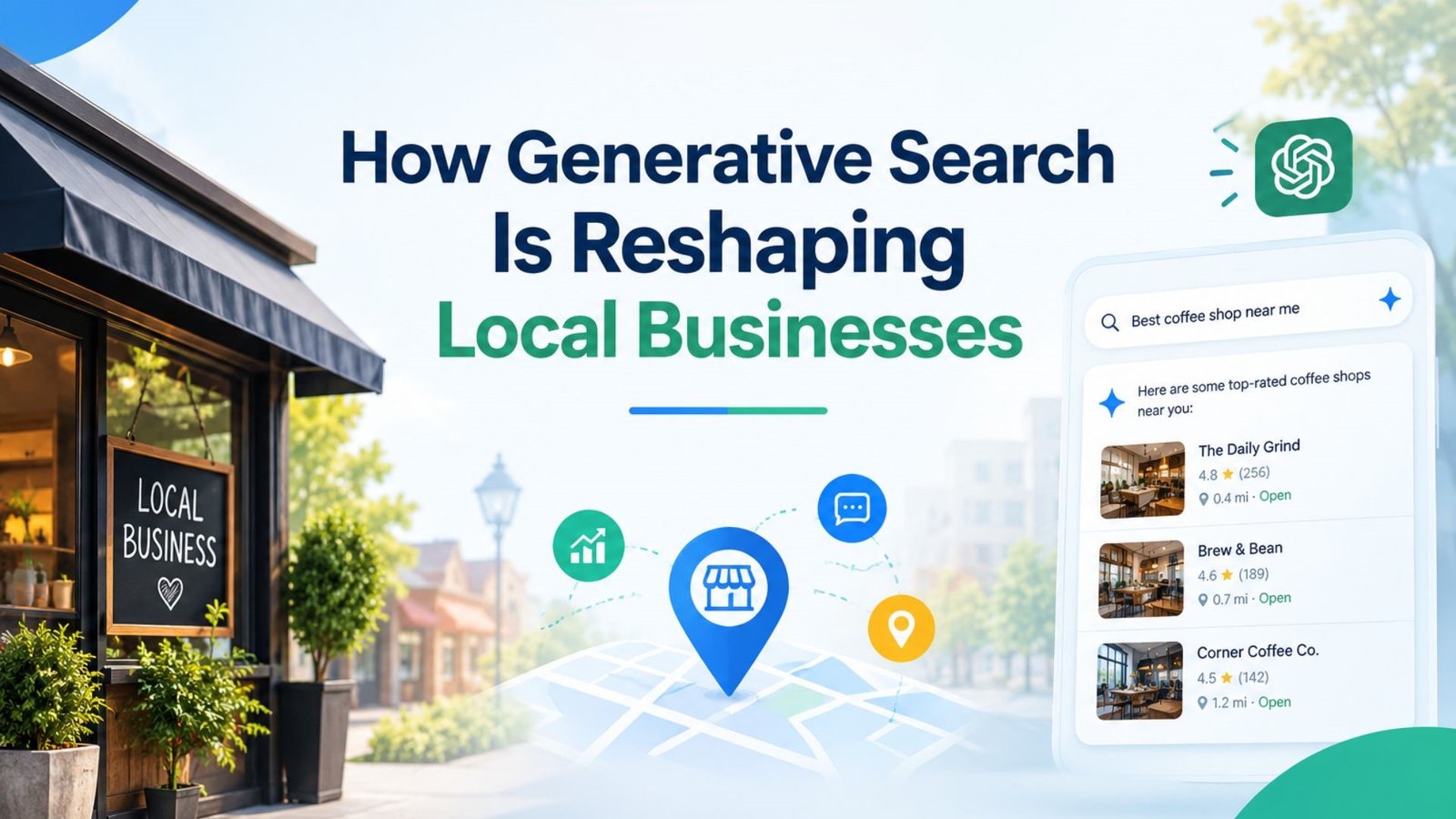
Generative search is changing how people find local businesses. Instead of showing ten blue links, tools like Google AI Overviews, ChatGPT and Perplexity now give a short, direct answer with two or three business names attached. Customers read the answer, pick one, and call. They often never visit a website. This means your Google Business Profile, reviews and website content matter more than ever, because AI tools pick their answers from this data. If your business is not clear, complete and trusted online, you simply do not get picked. That is the core shift happening right now.
What Changed, In Plain Words
Search used to be a list. You typed a question, Google showed pages, and you clicked one. Generative search skips that step. The AI reads many sources – your website, your Google profile, reviews, directories – and writes one answer. It then names a few businesses as proof.
This is why fewer people click through to websites today. Search is becoming an “answer engine,” not a “link engine.” For local businesses, this is not small. A plumber, dentist, or bakery that used to get found through search rankings now needs to get mentioned inside an AI-written answer instead.
👉 Also Read: GEO vs. Traditional SEO: Key Differences You Need to Know
Why Some Businesses Get Picked and Others Don't
AI systems don’t just look at popularity. They look for clear, consistent and provable facts. A business with matching name, address and phone number everywhere online looks trustworthy. One with outdated hours, mismatched addresses, or no recent reviews looks risky, and AI tools avoid recommending risky answers.
A Framework Most Guides Don't Mention: The Trust Stack
Most articles just say “improve your SEO” or “get more reviews.” Here is a more useful way to think about it – three layers that generative search checks, in order, before it trusts your business enough to mention it:
Layer 1 — Identity Proof Your name, address, phone number, and hours must match exactly across your website, Google profile, and every directory. Even one mismatch (like “St.” vs “Street”) can quietly push AI tools toward a competitor with cleaner data.
Layer 2 — Recency Signal AI tools favor businesses that show recent activity: new photos, recent reviews, updated posts. A profile untouched for six months reads as possibly closed or unreliable, even if it isn’t.
Layer 3 — Answer-Ready Content Your website should answer common customer questions in plain sentences, not just list services. For example, instead of “HVAC Repair,” write “We fix broken air conditioners the same day in [city].” AI tools pull sentences like this directly into their answers.
Most businesses only work on Layer 1. Businesses that build all three layers show up far more often in AI-generated answers.
👉 Also Read: Why Businesses Need to Optimize for AI Search, Not Just Google
What This Means for You
- Keep your business details identical everywhere online.
- Post updates and photos often, even small ones.
- Write your website in plain, question-answering sentences.
- Ask happy customers for reviews regularly, not just once.
- Check what AI tools currently say about your business, and fix anything wrong.
The Bigger Picture
Generative search is not replacing local businesses – it is replacing how they get discovered. The businesses that win will not always be the biggest ones. They will be the ones with the clearest, most trustworthy information online. That is good news: it means smaller, well-run local businesses now have a real chance to be picked over bigger competitors with messy or outdated data.
Start with your Google Business Profile this week. Make sure it is complete, accurate and active. That one step alone puts you ahead of most local competitors who have not adjusted to this new kind of search yet.
FAQs
Generative search is when AI tools like Google AI Overviews, ChatGPT, or Perplexity write a direct answer to a question instead of showing a list of links, often naming a few businesses as part of that answer.
Normal search shows you pages to click. Generative search reads those pages for you and gives you one short answer, so fewer people click through to websites.
Because customers now get business names straight from the AI answer. If your business isn’t mentioned, you lose the lead before the customer even sees a list of options.
Keep your name, address and phone number the same everywhere online, post updates and photos often, collect reviews regularly, and write website content that answers real customer questions in plain sentences.
No. It builds on it. Good local SEO basics, like an accurate Google Business Profile and consistent listings, are still the foundation AI tools rely on to trust and mention your business.
Not necessarily. It can actually help small businesses, since AI tools reward clear, trustworthy information over size. A well-run small business can be picked over a bigger competitor with outdated or messy data.