
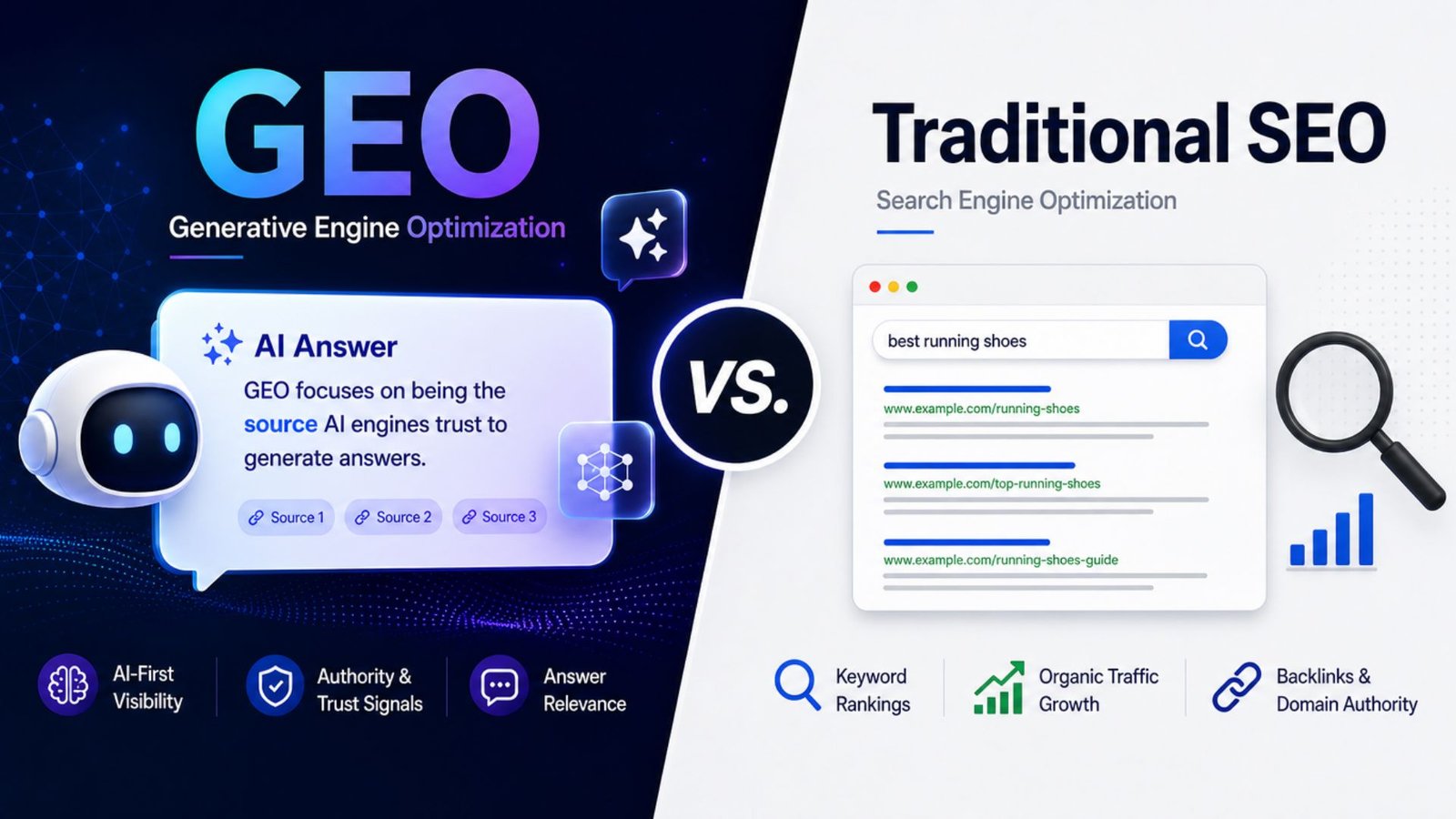
Search is splitting into two paths. One leads users to a results page full of links. The other leads them straight to an AI-generated answer. Traditional SEO was built for the first path. GEO (Generative Engine Optimization) is built for the second.
They share some DNA, but the mechanics, goals, and success metrics are different enough that treating them as the same discipline will hold your content back. Here’s a direct, side-by-side comparison of how they differ.
Quick Comparison Table
Factor | Traditional SEO | GEO |
Primary goal | Rank high on search engine results pages (SERPs) | Get cited, quoted, or referenced inside AI-generated answers |
Success metric | Rankings, organic traffic, click-through rate (CTR) | Citation frequency, mention rate, share of voice in AI answers |
User outcome | User clicks through to your website | User may get their answer without ever visiting your site |
Content structure | Keyword-optimized pages, long-form articles | Clear, extractable answers; scannable structure (headers, lists, tables) |
Ranking signals | Backlinks, keyword density, site speed, mobile-friendliness | Authority, trustworthiness, clarity, structured data, freshness |
Where content appears | Google, Bing, Yahoo search results | ChatGPT, Perplexity, Google AI Overviews, Bing Copilot, Claude |
Content format that wins | Optimized for search intent + keywords | Optimized for direct, quotable, fact-forward answers |
Measurement tools | Google Search Console, Ahrefs, SEMrush | Emerging GEO tracking tools, AI citation monitors |
Core discipline | Keyword targeting, on-page SEO, link building | Answer clarity, topical authority, source credibility |
Time to see results | Weeks to months (algorithm-dependent) | Still evolving — no fixed benchmark yet |
1. Goal: Ranking vs. Citation
Traditional SEO aims to get your page to appear as high as possible on a search engine results page. The end goal is a click – a user sees your listing, clicks it, and lands on your site.
GEO aims for something different: getting your content selected, paraphrased, or directly quoted inside an AI-generated response. The user might get their answer without ever clicking a link. Your “win” isn’t a visit – it’s a mention.
2. Success Metrics: Traffic vs. Visibility
Traditional SEO is measured with familiar metrics: keyword rankings, organic traffic, click-through rate, and bounce rate. These are tracked through tools like Google Search Console.
GEO doesn’t have a mature, standardized measurement system yet. Marketers are instead tracking how often a brand or page is cited in AI answers, how content is represented in generated summaries, and overall “share of voice” across AI platforms.
3. Content Structure: Keyword-Optimized vs. Extraction-Optimized
Traditional SEO content is often built around target keywords, search intent, and complete coverage of a topic – sometimes resulting in long, detailed articles designed to rank for multiple search queries.
GEO content prioritizes clarity and extractability. AI engines tend to favor content that states the answer plainly and early, uses clear headers, bullet points, and tables, and avoids burying key points in long paragraphs. The structure itself becomes a ranking factor.
4. Ranking Signals: Backlinks vs. Trust Signals
Traditional SEO relies heavily on backlinks, keyword density, technical performance (site speed, mobile optimization), and on-page SEO elements like title tags and meta descriptions.
GEO leans more on E-E-A-T – style trust signals – expertise, authoritativeness, and trustworthiness – along with structured data, factual accuracy, and content freshness. Backlinks still matter, but they’re one signal among several rather than the dominant one.
5. Where Content Shows Up
Traditional SEO targets classic search engines: Google, Bing, and Yahoo, where results appear as ranked lists of links.
GEO targets generative AI platforms: ChatGPT, Perplexity, Google AI Overviews, Bing Copilot, and similar tools, where results appear as a synthesized, conversational answer often drawing from multiple sources at once.
6. Winning Content Format
Traditional SEO rewards complete content that satisfies search intent across a range of related keywords – often favoring depth and breadth.
GEO rewards content that answers a specific question clearly and concisely, backed by credible data, and structured so an AI model can lift the answer accurately without misrepresenting it.
Where GEO and Traditional SEO Overlap
Despite their differences, GEO and traditional SEO aren’t opposing strategies – they share common ground:
- Both depend on quality, accurate content
- Both benefit from topical authority and credibility
- Both use structured data to help machines understand content
- Both require regular updates to stay relevant
- Both are impossible to fully “game” – genuine expertise and clarity win in each
Good GEO is largely built on a foundation of good SEO. You can’t skip one to succeed at the other.
Which One Should You Focus On?
Not an either/or decision. As AI-driven search grows alongside traditional search, both channels are actively driving visibility and traffic. The safest approach is treating GEO as an extension of your existing SEO strategy – not a replacement for it.
- If your content already ranks well but isn’t structured for direct answers, start applying GEO principles on top of what you have.
- If you’re building content from scratch, aim for both from day one: keyword-relevant, well-linked, and clearly structured for extraction.
Key Takeaways
- Traditional SEO optimizes for rankings and clicks; GEO optimizes for citations and visibility inside AI answers.
- GEO doesn’t replace SEO – it builds on the same foundation of authority, quality, and relevance.
- Content structure (clear answers, headers, lists) matters more in GEO than in traditional SEO.
- Measurement for GEO is still maturing, unlike the well-established metrics used in traditional SEO.
- The strongest strategy combines both: rank well and get cited.
FAQs for the GEO vs. Traditional SEO
Traditional SEO optimizes content to rank on search engine results pages and drive clicks, while GEO optimizes content to be cited or referenced directly inside AI-generated answers, regardless of whether the user clicks through.
No. GEO builds on top of traditional SEO fundamentals like authority, quality content, and structured data. It adds an extra layer focused on clarity and extractability for AI engines rather than replacing SEO practices entirely.
Traditional SEO success is measured through rankings, organic traffic, and click-through rate using tools like Google Search Console. GEO success is measured through citation frequency and share of voice in AI-generated answers, though standardized tracking tools are still emerging.
Backlinks remain a major ranking factor in traditional SEO. In GEO, backlinks still contribute to authority, but trust signals like expertise, accuracy, and content freshness carry more relative weight.
Neither should be prioritized at the expense of the other. The most effective approach combines both – building content that ranks well in traditional search while also being clearly structured for AI engines to cite.