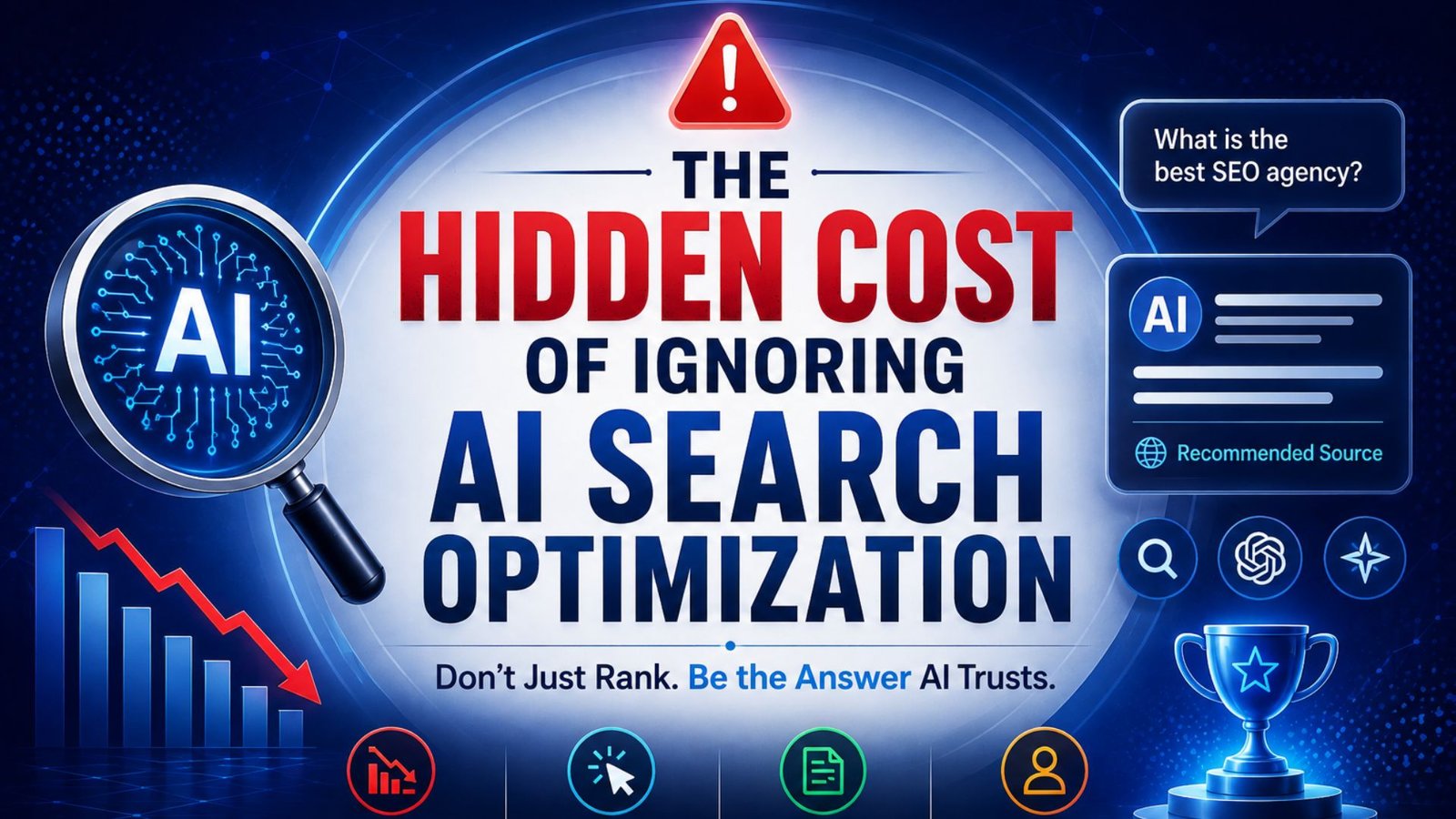
Ignoring AI Search Optimization can cost your business more than website traffic – it can cost you brand visibility, AI citations, qualified leads, and customers. As people increasingly use Google AI Overviews, AI Mode, ChatGPT, Perplexity, and other AI search tools, businesses need to optimize not only for rankings but also for AI visibility.
The key question is no longer:
“Does my website rank on Google?”
It is:
“Will AI recommend or cite my business when customers ask relevant questions?”
What Is AI Search Optimization?
AI Search Optimization is the process of making your website easier for AI-powered search engines to understand, trust, mention, and cite.
It overlaps with:
- AI SEO
- Generative Engine Optimization (GEO)
- Answer Engine Optimization (AEO)
- Traditional SEO
The goal is simple: become a reliable source for both search engines and AI systems.
The Hidden Costs of Ignoring AI Search
1. Losing Visibility to Competitors
A customer may ask:
“What are the best SEO agencies for a small manufacturing business?”
Instead of seeing 10 search results, they may receive a short AI-generated recommendation.
If your competitor is mentioned and you are not, you can lose the customer before they ever visit Google search results.
2. Losing Website Clicks
AI answers can provide information without requiring users to visit a website.
Pew Research found that users clicked a traditional Google result in 8% of visits when an AI summary appeared, compared with 15% when there was no AI summary.
This makes AI visibility increasingly important alongside traditional organic rankings.
3. Missing AI Citations
AI search platforms can cite websites as sources.
For example:
Customer: “How do I choose an SEO agency?”
If your comprehensive SEO guide is cited, your brand gets visibility during a high-intent search.
The opportunity could scale from:
10 questions → 50 questions → 100+ questions
That is why creating content worth citing matters.
4. Generic Content Won't Build Authority
Publishing dozens of generic AI-written articles does not automatically create topical authority.
Instead of:
“SEO helps businesses increase online visibility.”
Create content with:
- Original data
- Expert opinions
- Case studies
- Real examples
- Industry insights
- First-hand experience
- Practical solutions
Don’t create more content. Create more useful content.
5. Missing Long-Tail Searches
AI search encourages conversational queries.
Compare:
“SEO agency”
with:
“How should a manufacturing company choose an SEO agency?”
The second query reveals much more about the customer’s search intent.
Create content around questions customers ask before making a purchase.
- Awareness
- Research
- Comparison
- Evaluation
- Decision
- What is SEO?
- How does SEO generate leads?
- SEO vs PPC - which is better?
- How much does SEO cost?
- How do I choose an SEO agency?
This builds stronger topical authority.
SEO vs AI Search Optimization
Traditional SEO | AI Search Optimization |
Focuses on rankings | Focuses on AI visibility |
Targets keywords | Targets questions and intent |
Measures clicks | Measures mentions and citations too |
Builds backlinks | Builds authority and trust |
Optimizes pages | Builds topical ecosystems |
You don’t need SEO or AI SEO. You need both.
How to Optimize for AI Search
1. Answer Questions Directly
Give the answer early.
Use headings such as:
- What is…?
- How does…?
- Why is…?
- How much does…?
- What is the difference between…?
2. Build Topic Clusters
For an SEO website, create connected content around:
SEO Services → Technical SEO → Local SEO → On-Page SEO → Keyword Research → SEO Audit → AI SEO → GEO
3. Show Expertise
Include:
- Authors
- Experience
- Case studies
- Original research
- Examples
- Expert insights
4. Strengthen Your Business Entity
Keep your:
- Company name
- Services
- Location
- Contact details
- Business profiles
- Social profiles
consistent across the web.
5. Use Structured Data
Implement relevant Schema Markup such as:
- Organization
- LocalBusiness
- Article
- Service
- FAQ
- Breadcrumb
Schema does not guarantee AI citations, but it can help search engines better understand your content.
What Should You Measure?
Traditional SEO metrics are still important:
- Rankings
- Organic traffic
- Impressions
- CTR
- Backlinks
- Leads
Add AI-focused metrics:
- AI mentions
- AI citations
- Brand visibility
- Competitor mentions
- AI-generated recommendations
- AI-assisted leads
A website with 7,000 qualified visitors and strong AI visibility can potentially outperform one with 10,000 visitors but weak conversion and brand visibility.
Traffic is not the only measure of search success anymore.
The Bottom Line
The hidden cost of ignoring AI Search Optimization is not simply losing clicks.
It is losing the opportunity to become the business that AI recommends before customers reach traditional search results.
The future of SEO is moving toward:
SEO + AI SEO + GEO + AEO + Brand Authority
The goal is simple:
"Don't just rank for the question. Become the source AI trusts enough to recommend."
FAQs
AI Search Optimization helps websites become easier for AI search engines to understand, recommend, and cite.
No. AI SEO complements traditional SEO. Technical SEO, content quality, backlinks, and authority remain important.
Generative Engine Optimization (GEO) focuses on improving visibility in AI-generated search results and answers.
Create original, useful, authoritative content, answer specific questions clearly, maintain accurate business information and ensure search crawlers can access your website.
Detailed guides, original research, case studies, comparisons, expert content, FAQs and pages that provide clear answers to specific questions.
Yes. AI search optimization can help smaller businesses compete for highly specific questions, industries, locations, and customer needs.
Creating large amounts of generic AI-generated content instead of publishing original, experience-based and useful information.