Most businesses post the same things: a discount, a new offer, a “call us today” banner. Then they wonder why the likes come in but the enquiries don’t.
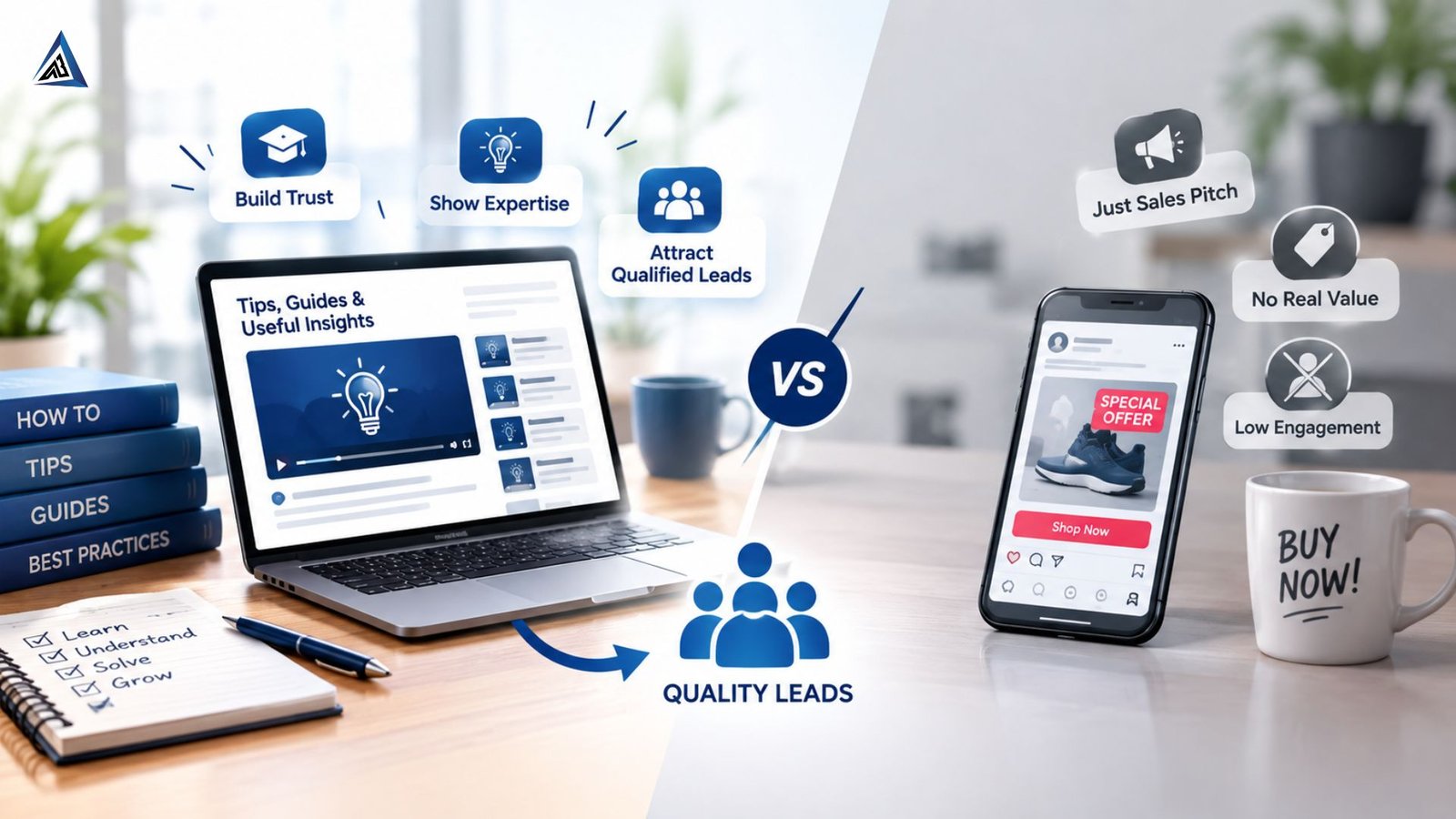
The problem usually isn’t the product or the budget. It’s the type of content. Promotional content asks for a sale before the customer trusts you. Educational content earns that trust first, and that is why it brings in better leads.
What Is Educational Content?
Educational content answers the questions your customers already have. It helps them understand a problem, compare options or make a decision, without pushing them to buy.
Examples include:
- How-to guides and step-by-step blogs
- Short videos and Reels explaining a common mistake
- Comparison posts (“Option A vs Option B”)
- FAQs, checklists and templates
- Case studies that show how a problem was solved
Promotional content, by contrast, talks about you: your offer, your price, your sale. It has its place, but it works best on people who are already ready to buy. Most of your audience isn’t there yet.
1. It Reaches People Who Are Already Searching
Nobody types “buy digital marketing services” every time they have a problem. They search for things like “why am I not getting calls from Google Maps” or “how much should a small business spend on ads.”
A blog or video that answers that question puts you in front of someone with a real, active need. A promotional post only reaches people who happen to scroll past it.
This is also why educational content supports your SEO. Search engines, and increasingly AI search tools, reward pages that give clear, useful answers. If you want to understand how that works, read our guide on 5 things AI search engines look for in content.
2. It Builds Trust Before the Sales Conversation
When a business explains something clearly and honestly, the reader thinks, “These people know what they’re doing.” By the time they contact you, they have already decided you’re credible.
Compare that with a cold promotional ad. The customer has to judge you in a few seconds, with nothing to go on but a headline and a price. Trust built through education shortens the sales cycle because you spend less time convincing and more time quoting.
3. It Attracts Higher-Quality Leads
Promotional content often brings price-shoppers. They respond to the discount, compare five quotes, and leave.
Educational content filters your audience. People who read a 1,000 word guide on a topic are genuinely interested in solving it. They arrive informed, ask better questions, and are more likely to become long-term clients rather than one-time bargain hunters.
4. It Keeps Working Long After You Publish It
A promotional post lasts a day or two. An educational blog can bring in enquiries for months or years. It ranks on Google, gets shared, and can be reused as a social post, an email, a short video or a WhatsApp reply to a customer.
For a small business, that is the difference between paying for attention every time and building an asset that keeps paying back. It’s also how you build topical authority, where search engines see you as a reliable source on a subject because you cover it in depth.
5. It Fixes the “Likes but No Enquiries” Problem
Many businesses are active on social media but don’t get leads. Engagement without enquiries usually means the content entertains or advertises but never guides the viewer toward a decision.
Educational posts fix this because each one gives the viewer a reason to take the next step: save the post, visit your profile, message you for help. If this sounds familiar, our post on what to do when a post gets likes but no enquiries goes deeper.
6. It Makes Your Paid Ads Perform Better
Educational content isn’t only for organic reach. People who have already read your guide or watched your video are warmer when they see your ad. That lowers your cost per lead and improves conversion.
A simple funnel looks like this: educational content at the top to attract, a case study or comparison in the middle to build confidence, and a promotional offer at the bottom to close. We explain the structure in our Facebook Ads funnel strategy guide, and our Pay Per Click team builds campaigns around it.
How to Balance Educational and Promotional Content
You don’t have to stop promoting. The goal is the right mix. A practical starting point:
- 70% educational: tips, guides, FAQs, myth-busting, explainers
- 20% proof: testimonials, case studies, before-and-after results
- 10% promotional: offers, launches, direct calls to action
Every educational piece should still end with a clear next step, such as “Get a free audit,” “Message us for a quote” or “Download the checklist.” Education without a call to action is just a nice article. Education with one is a lead generator.
Practical Ideas to Start This Week
- List the 10 questions customers ask you most often, and turn each into a post or blog.
- Record a 60-second video answering one common mistake in your industry.
- Turn one blog into five social posts (a tip, a stat, a myth, a checklist, a question).
- Add a simple call to action to every post.
- Track enquiries, not just likes, to see which topics actually bring leads.
If you’re not sure where to begin, our step-by-step guide to getting more customers is a good companion read.
Final Thoughts
Promotional content tells people what you sell. Educational content shows them why you’re the right choice. For lead generation, the second approach almost always wins, because it attracts people with real intent, builds trust before the first call, and keeps working long after it’s published.
Want help building a content plan that brings in enquiries instead of just likes? Our digital marketing and social media marketing team can map one out for your business. Get a free audit today.