
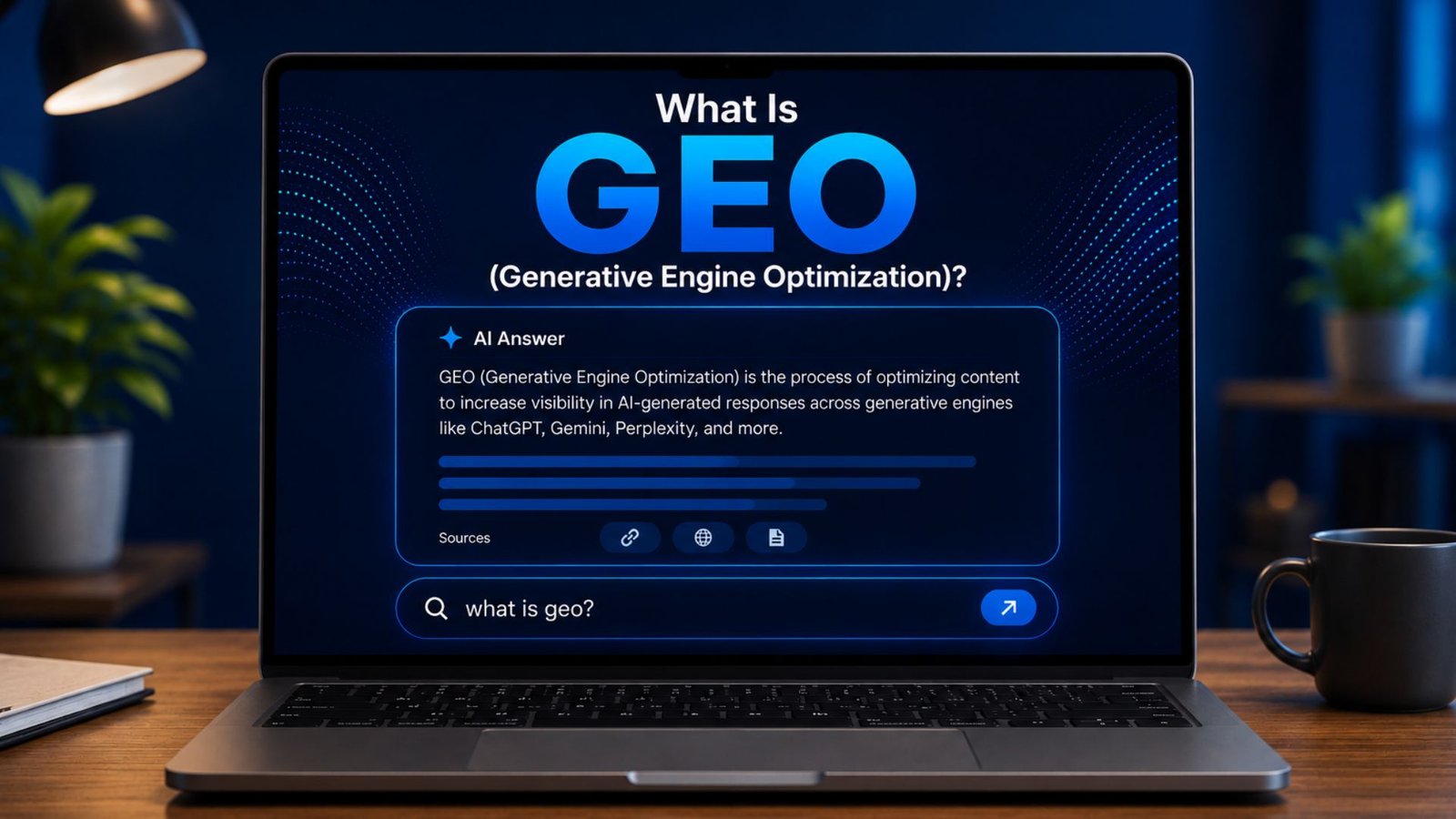
If you’ve spent any time in marketing or SEO circles lately, you’ve probably run into the acronym “GEO.”
No, it’s not about maps – it stands for Generative Engine Optimization, and it’s quickly becoming one of the most talked-about shifts in how content gets discovered online.
This guide breaks down what GEO actually means, how it differs from traditional SEO, and what you can start doing today to adapt.
What Is GEO?
GEO is the practice of optimizing content so it gets surfaced, cited, or summarized by AI-powered answer engines – tools like ChatGPT, Google’s AI Overviews, Perplexity, Claude and Bing Copilot. Instead of a search engine returning a list of blue links, these tools generate a direct, conversational answer, often pulling information from a handful of sources.
In short: traditional SEO gets you ranked. GEO gets you cited – or paraphrased – inside an AI-generated response.
Why GEO Matters Now
A growing share of searches never make it to a traditional results page. People are asking AI chatbots questions directly and getting synthesized answers on the spot. If your content isn’t structured or positioned to be picked up by these systems, you risk becoming invisible in a large and growing slice of search behavior – even if you rank #1 on Google.
How GEO Differs from Traditional SEO
Traditional SEO | GEO |
Optimizes for ranking position | Optimizes for being cited/quoted |
Success = clicks to your site | Success = visibility inside the answer itself |
Keyword targeting is central | Clear, extractable answers matter more |
Backlinks are a major ranking factor | Trustworthiness, structure, and clarity carry more weight |
Measured with rankings, CTR | Measured with citation/mention frequency, share of voice |
The two aren’t mutually exclusive – good GEO still relies on many SEO fundamentals (authority, relevance, quality content). But GEO adds a new layer: writing in a way that’s easy for AI models to extract, summarize, and trust.
How AI Engines Choose What to Cite
While each platform works differently, most generative engines tend to favor content that is:
- Clear and well-structured — using headers, lists and direct answers rather than long, meandering paragraphs
- Authoritative — from sources with established credibility (aligns with Google’s E-E-A-T principles: Experience, Expertise, Authoritativeness, Trustworthiness)
- Fact-forward — answers the question early and explicitly, rather than burying the point
- Well-cited itself — content that references credible data, studies or original research
- Recently updated — freshness signals still matter, especially for time-sensitive topics
Core Principles of GEO
1. Lead With the Answer
AI models tend to pull directly from content that states the answer plainly near the top, rather than content that builds up to a conclusion. Think “inverted pyramid” journalism style.
2. Structure for Extraction
Use headers, bullet points, tables and short paragraphs. Structured content is easier for AI systems to parse and lift accurately.
3. Build Topical Authority
Publishing comprehensive, interlinked content on a subject signals expertise – both to search engines and to AI models trained (or retrieving in real time) on the web.
4. Back Up Claims With Data
Original statistics, studies and expert quotes increase the odds your content gets treated as a credible source worth citing.
5. Keep Content Fresh
Outdated information is less likely to be trusted or surfaced, especially on fast-moving topics.
6. Don’t Abandon Traditional SEO
Technical SEO, site speed, mobile-friendliness, and backlinks still matter. GEO builds on top of solid SEO fundamentals rather than replacing them.
Common Misconceptions About GEO
- “GEO is a replacement for SEO.” Not quite – think of GEO as an evolution or extension of SEO practices for a new discovery surface.
- “There’s a secret formula to get cited.” No platform has published an exact algorithm, and best practices are still evolving through observation and testing.
- “GEO only matters for big brands.” Smaller, niche sites with clear, authoritative content can and do get cited — sometimes more easily than large sites with thin content.
How to Get Started With GEO
- Audit your existing content for clarity and structure – are your key points easy to extract?
- Add clear, direct answers near the top of key pages, especially for question-based queries.
- Use structured data (schema markup) to help machines understand your content.
- Strengthen E-E-A-T signals – author bios, credentials, citations, and original data.
- Track your presence in AI-generated answers using emerging GEO monitoring tools.
- Keep iterating – this space is new, and best practices will continue to shift.
The Bottom Line
GEO isn’t about abandoning what you already know about SEO – it’s about extending those skills to a new kind of search experience. As more users turn to AI tools for direct answers, optimizing your content to be clear, credible, and citation-worthy will become just as important as ranking on page one.
The brands that start experimenting now – testing content structure, tracking AI citations, and refining based on results will have a head start as this discipline matures.
FAQs about GEO
GEO stands for Generative Engine Optimization – the practice of optimizing content so it gets surfaced, cited, or summarized by AI-powered answer engines like ChatGPT, Google AI Overviews, and Perplexity.
No, but they’re closely related. Traditional SEO focuses on ranking in search results so users click through to your site. GEO focuses on getting your content cited or referenced directly inside AI-generated answers, even if the user never visits your page.
More users are getting answers directly from AI chatbots instead of clicking through traditional search results. If your content isn’t structured to be picked up by these tools, you risk losing visibility even if you rank well on Google.
No. GEO builds on top of SEO fundamentals like authority, relevance, and technical performance. You still need solid SEO – GEO adds an extra layer focused on AI extractability and trust.
While each platform differs, most favor content that is clearly structured, authoritative, fact-forward, well-cited, and regularly updated – closely aligned with Google’s E-E-A-T principles.
Start by auditing existing content for clarity, adding direct answers near the top of key pages, using structured data/schema markup, and strengthening credibility signals like author bios and citations.
Yes. Niche sites with clear, authoritative, well-structured content can get cited by AI engines – sometimes more easily than larger sites with thin or unfocused content.
Since GEO isn’t about click-through rates alone, success is typically measured by citation frequency, brand mentions in AI answers, and share of voice within AI-generated responses – tracked using emerging GEO monitoring tools.