Running Google Ads can bring potential customers to your business almost immediately.
But there is a problem many businesses overlook:
Getting people to click your ad is only half the job.
What happens after the click matters just as much.
If your landing page is confusing, slow, generic, difficult to navigate, or doesn’t match what the ad promised, you can end up paying for traffic that never becomes a lead.
This is one of the most expensive mistakes businesses make with paid advertising.
They try to fix a traffic problem when the real problem is their landing page and conversion process.
The Problem: You're Paying for Traffic Before You're Ready for It
Imagine you own a business that provides web development services.
You create a Google Ads campaign targeting:
“Custom Website Development Company“
You write a strong advertisement:
Custom Websites for Growing Businesses
Fast, Responsive & Built for Conversions
Get a Free Consultation
Someone searches for the service.
They see your ad.
They click.
You pay for the click.
But instead of taking them to a dedicated page explaining your custom website development service, you send them to your homepage.
The visitor now has to figure out:
- What exactly do you offer?
- Do you work with businesses like theirs?
- How much does it cost?
- Why should they choose you?
- What should they do next?
- Where can they contact you?
You’ve successfully paid for their attention.
But you’ve made them work for the answer.
And many won’t.
This is where advertising budgets quietly disappear.
Why Google Ads Can't Fix a Bad Landing Page
Google Ads can help you reach people who are searching for your products or services.
It can potentially increase:
- Website traffic
- Brand visibility
- Enquiries
- Calls
- Form submissions
- Sales
But advertising cannot automatically fix what happens after someone lands on your website.
Think about it this way:
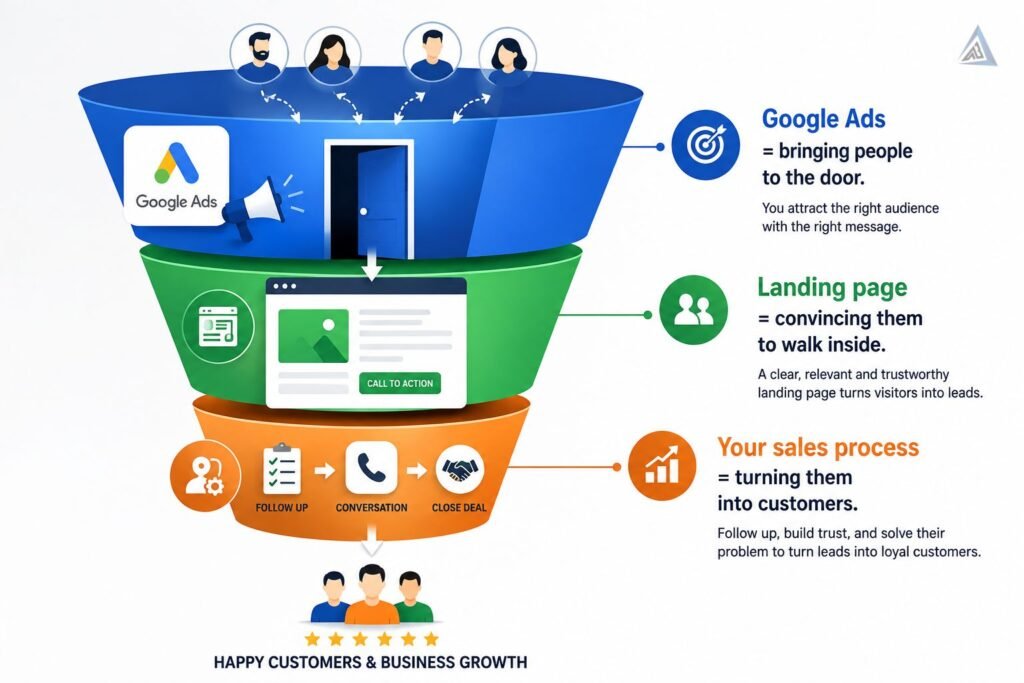
Google Ads = bringing people to the door.
Landing page = convincing them to walk inside.
Your sales process = turning them into customers.
If the middle part is broken, increasing traffic simply gives you more people experiencing the same problem.
The Real Cost of a Poor Landing Page
The obvious cost is the money you spend on clicks.
But the actual cost can be much bigger.
A weak landing page can create:
- Wasted ad spend: You pay for visitors who leave without taking action.
- Lower lead volume: The campaign may generate clicks but very few enquiries.
- Poor lead quality: If your offer isn’t clearly explained, you may attract people who aren’t the right fit.
- Higher customer acquisition cost: When fewer visitors convert, you need more traffic to generate the same number of leads.
- Bad campaign decisions: This is particularly dangerous.
A business owner sees poor results and thinks:
Google Ads doesn't work for my business.
So they change keywords.
Then the ads.
Then the targeting.
Then the budget.
But the real problem was the landing page.
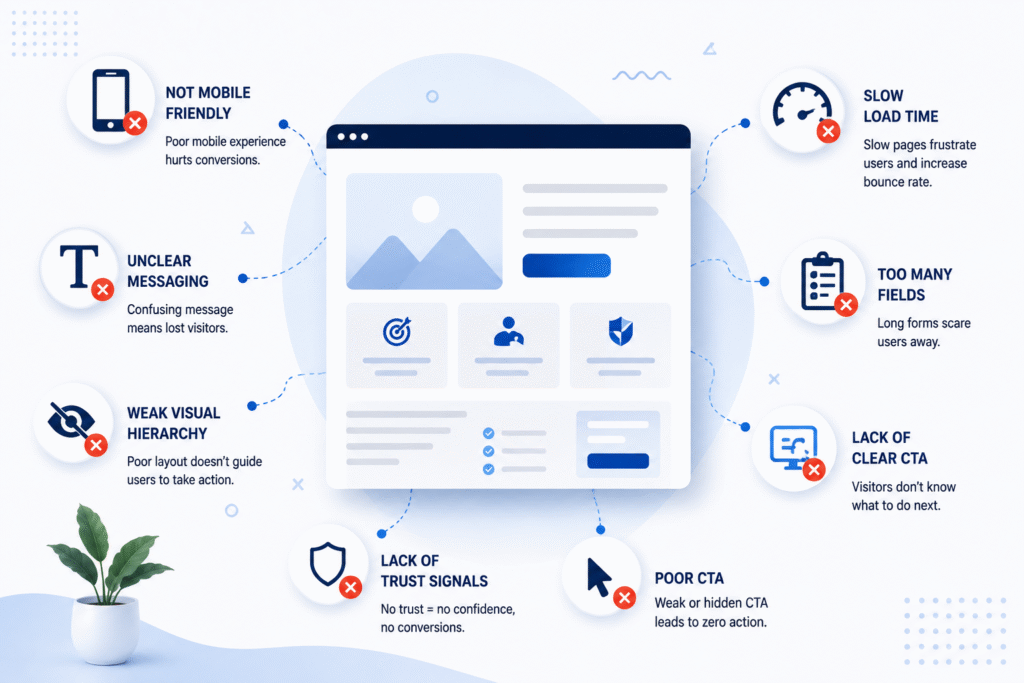
7 Landing Page Problems You Should Fix Before Running Ads
1. Your Landing Page Doesn't Match the Ad
This is one of the biggest problems.
Suppose your advertisement says:
“Get a Free SEO Audit for Your Business.“
The visitor clicks and lands on a page saying:
“Welcome to ABC Digital Marketing.”
That’s a disconnect.
The visitor expected an SEO audit.
Instead, they received a generic company introduction.
Your landing page should continue the conversation started by the advertisement.
If the ad talks about: SEO services
the landing page should immediately talk about: SEO services.
If the ad promotes: Website development
the landing page should immediately explain: Website development.
The visitor should feel:
"Yes, I'm in the right place."
2. You're Sending Paid Traffic to Your Homepage
Your homepage is designed to introduce your entire business.
A paid advertising landing page has a different job.
A homepage might contain:
- About us
- Services
- Blog
- Portfolio
- Careers
- Contact
- Multiple CTAs
- Several navigation options
That’s useful for general website visitors.
But someone coming from an advertisement usually has a specific intent.
They clicked because they were interested in one particular thing.
Don’t make them search your entire website for it.
Instead, create a focused landing page around the offer.
For example:
Ad → SEO Service Landing Page → Consultation
Rather than:
Ad → Homepage → Services → SEO → Contact
Every additional step creates another opportunity for the visitor to leave.
3. Your Value Proposition Isn't Clear
One of the first questions a visitor asks is:
“What’s in it for me?”
If your landing page starts with:
"Welcome to our company. We are a leading digital marketing agency with years of experience..."
you haven’t answered the most important question.
Instead, communicate the outcome.
For example:
Generate More Qualified Leads With Data-Driven SEO
Then explain:
- What you do
- Who it’s for
- What problem you solve
- Why your approach is different
- What the visitor should do next
Your visitor shouldn’t need to read five paragraphs to understand your offer.
4. You Have Too Many CTAs
Another common problem is trying to make the visitor do everything.
You might have:
- Buy Now
- Call Us
- Download Brochure
- Subscribe
- Book a Meeting
- Learn More
- WhatsApp Us
- Follow Us
- Read Our Blog
The visitor now has too many choices.
A campaign landing page should have a primary conversion goal.
For example:
- For a B2B service: Book a Free Consultation
- For an SEO service: Request an SEO Audit
- For web development: Get a Website Quote
- For an e-commerce product: Buy Now
You can have supporting actions, but one action should clearly dominate.
5. You're Asking for Too Much Information
Imagine someone wants a free consultation.
Your form asks for:
- Full name
- Company name
- Job title
- Phone
- Company size
- Website
- Monthly revenue
- Marketing budget
- Industry
- Address
- Business registration number
- Message
That’s a lot of commitment before the visitor has even decided whether they trust you.
Ask for the information you genuinely need.
For example:
- Name
- Business email
- Phone
- Website
- What do you need help with?
That’s enough to start many B2B conversations.
You can collect additional information later.
6. Your Landing Page Doesn't Build Enough Trust
People don’t give their money or personal information to a business simply because an advertisement appeared in front of them.
They need reasons to trust you.
Your landing page can use:
- Client testimonials
- Case studies
- Portfolio examples
- Reviews
- Results
- Certifications
- Industry experience
- Process explanation
- Clear contact information
- Real business details
Best Digital Marketing Company
#1 Web Development Agency
World's Leading SEO Experts
Show evidence instead.
Proof is stronger than self-praise.
7. You're Not Testing the Page
Launching the campaign doesn’t mean the work is finished.
Your first landing page is a starting point.
You should continuously ask:
- Are visitors clicking the CTA?
- Are they completing the form?
- Where are they leaving?
- Which device converts better?
- Which ad message brings better leads?
- Are people starting the form but abandoning it?
- Are leads actually becoming sales opportunities?
You don’t need to redesign everything every week.
Make one meaningful change at a time and learn from the data.
The Bigger Problem: Clicks Are Not Leads
This is where many businesses get confused.
- They celebrate: 10,000 impressions
- Then: 500 clicks
- But only: 5 enquiries
The campaign looks busy.
The dashboard looks active.
But the business isn’t growing.
That’s because:
Impressions ≠ Customers
Clicks ≠ Leads
Leads ≠ Sales
Your real objective should be moving people through the entire journey:
Search → Ad → Landing Page → Conversion → Lead → Sales Conversation → Customer
Every stage matters.
What Should You Fix Before Launching Google Ads?
Before spending serious money on advertising, go through this checklist.
Step 1: Define One Campaign Goal
Ask:
What exactly do I want this campaign to generate?
Choose one primary objective.
For example:
Qualified enquiries
Not:
"I want more traffic."
Traffic is a means.
Leads or sales are the business outcome.
Step 2: Understand the Search Intent
Don’t build your landing page around keywords alone.
Think about what the person actually wants.
Someone searching:
“SEO agency for small business“
is different from someone searching:
The first person may be looking for a service.
The second person may simply be researching.
Your landing page needs to reflect the intent behind the traffic.
Step 3: Build a Dedicated Landing Page
Don’t automatically send every campaign to the homepage.
Create a page specifically designed for the campaign.
A strong structure can look like:
Hero Section
Clear outcome:
Supporting explanation
Primary CTA
Trust indicator
↓
Problem
Show that you understand the customer’s situation.
↓
Solution
Explain what you provide.
↓
Benefits
Explain what changes for the customer.
↓
How It Works
Show your process.
↓
Proof
Testimonials, results, portfolio or case studies.
↓
FAQs
Remove common objections.
↓
Final CTA
Make the next step obvious.
Step 4: Make the Ad and Landing Page Tell the Same Story
This is one of the most important principles.
Your advertisement makes a promise.
Your landing page must fulfill that promise.
For example:
Advertisement
Custom Website Development for Growing Businesses
Fast, responsive and conversion-focused websites.
👉 Get a Free Consultation
Landing Page
Custom Website Development for Growing Businesses
We build fast, responsive and conversion-focused websites designed around your business goals.
👉 Book Your Free Consultation
The visitor immediately understands:
"I'm in the right place."
Step 5: Make Mobile Experience a Priority
A landing page can look excellent on a desktop and still perform poorly on mobile.
Check:
- Text size
- Button size
- Page speed
- Form usability
- Image loading
- Navigation
- Spacing
- CTA visibility
Open the page on an actual phone.
Don’t just resize the browser window on your laptop and assume everything is fine.
Step 6: Track the Entire Journey
Don’t stop tracking at clicks.
You need to understand:
Ad click
↓
Landing page visit
↓
CTA interaction
↓
Form submission
↓
Qualified lead
↓
Sales conversation
↓
Customer
This changes how you evaluate your campaign.
A campaign generating fewer leads can actually be better if those leads are more qualified and produce more revenue.
Step 7: Start With Controlled Testing
Don’t launch ten campaigns with ten different landing pages and immediately spend a large budget.
Start with a controlled setup.
Test:
- Audience: Who are you targeting?
- Offer: What are you giving them?
- Message: Why should they care?
- Landing page: Does it convert attention into action?
- CTA: Is the next step obvious?
Then improve based on actual behavior.
A Better Google Ads Strategy for 2026
The smarter approach isn’t:
Build ads → Get clicks → Hope for leads
It’s:
Research → Offer → Landing Page → Tracking → Ads → Test → Optimize
The order matters.
Before spending more money, make sure the destination deserves the traffic.
Modern ad platforms are becoming increasingly automated, which makes the quality of your conversion signals and the clarity of your offer even more important. But automation cannot compensate for a landing page that doesn’t clearly communicate value or guide the visitor toward the next step.
A Simple Pre-Ads Landing Page Audit
Before you launch, ask these 10 questions:
- Can someone understand what I offer within a few seconds?
- Does the page match the advertisement?
- Is the target customer obvious?
- Is the main benefit clear?
- Is there one obvious primary CTA?
- Can visitors trust my business?
- Is the form easy to complete?
- Does the page work properly on mobile?
- Can I track conversions correctly?
- Do I know what happens after someone submits the form?
If you can’t confidently answer these questions, your landing page probably needs work before you increase your advertising budget.
Don't Blame Google Ads Too Quickly
When a campaign doesn’t generate leads, businesses often blame:
"The keywords are too expensive."
or
"Google Ads doesn't work."
Sometimes that’s true.
But sometimes the problem is much closer to home.
The ad did its job.
The visitor clicked.
The landing page lost them.
That’s why your advertising strategy shouldn’t be judged only by:
- CPC
- CTR
- Impressions
- Clicks
Look at what happens after the click.
Because that’s where your money either starts creating business value or disappears.
The Solution: Fix the Funnel Before Increasing the Budget
If you’re planning to run Google Ads, don’t start with the advertising dashboard.
Start with the customer journey.
- Understand your audience.
- Define the offer.
- Build a dedicated landing page.
- Match your ad messaging with the page.
- Set up conversion tracking.
- Launch with a controlled budget.
- Review the quality of leads – not just the number.
- Finally: Optimize the campaign and landing page together.
Because a successful paid campaign isn’t simply about getting more people to your website.
It’s about getting the right people to the right page with the right message and making the next step easy.
Final Thought
You can have:
- The right keyword.
- The right audience.
- A great advertisement.
- A healthy advertising budget.
And still generate poor results.
Because if your landing page doesn’t convert attention into action, you’re simply paying more people to discover the same problem.
Fix the destination before you increase the traffic.
That’s one of the simplest ways to make your paid marketing budget work harder
Need Help Fixing Your Landing Page Before Running Ads
If you’re planning to invest in Google Ads but aren’t sure whether your landing page is ready, we can help.
At Abir IT Solution, we help businesses improve the complete digital journey from landing page design and web development to SEO, paid advertising and conversion-focused digital marketing.
Don’t spend more on traffic until you know your website can convert it.
👉 Get your landing page reviewed before launching your next campaign.
Build the right page. Send the right traffic. Generate better opportunities.