Getting traffic to your website is not the same as getting customers.
Many small businesses invest time and money in SEO (Search Engine Optimization) but still struggle to generate enquiries, calls, bookings, or sales. The problem is often not a lack of effort – it is using the wrong SEO strategy.
A website can rank for keywords and still fail to attract potential customers. It can receive visitors but generate very few enquiries. It can even appear on Google for several searches without producing measurable business growth.
Why?
Because effective SEO marketing is not simply about ranking higher. It is about reaching the right people, answering their questions, building trust, and making it easy for them to take action.
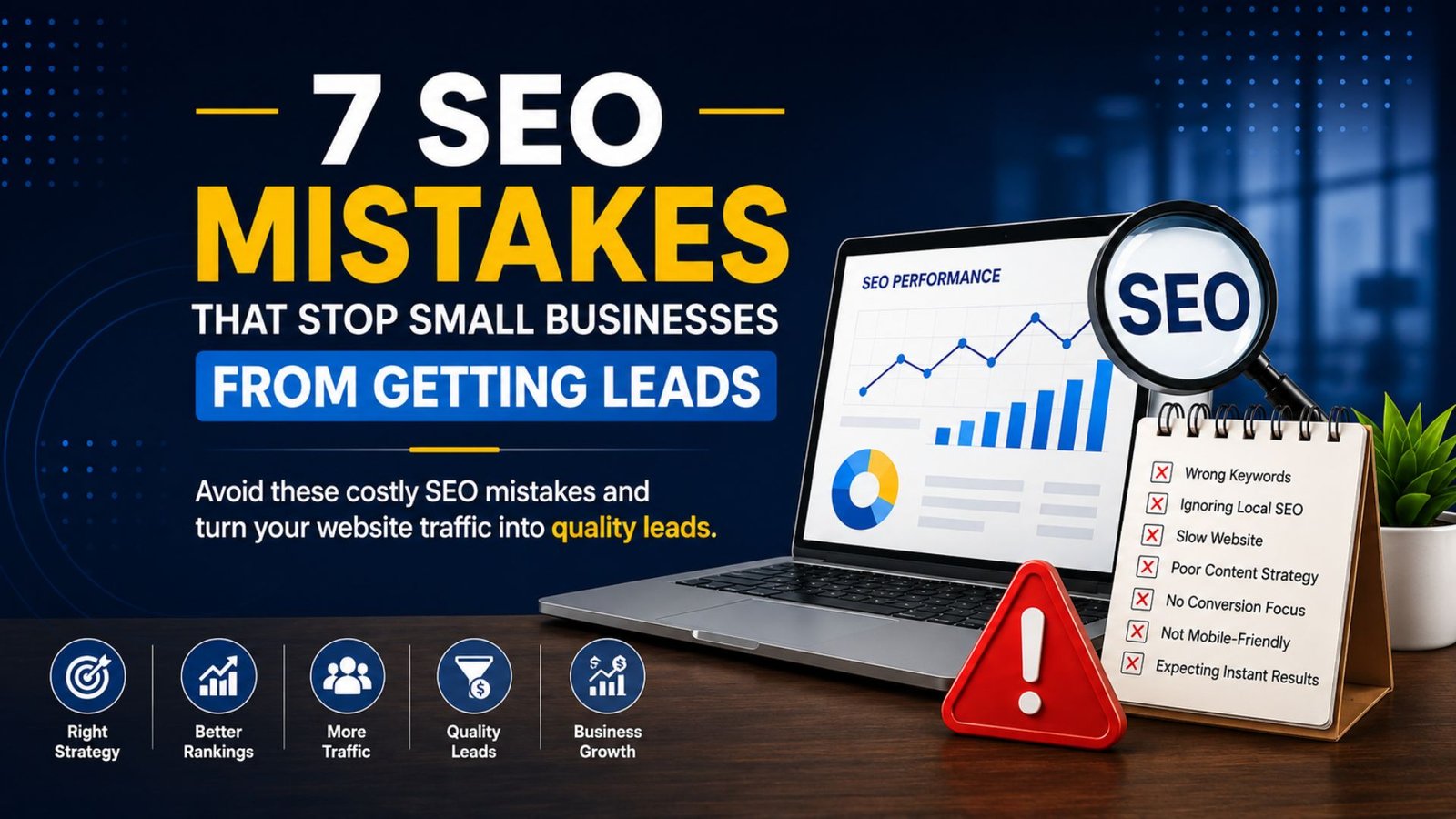
If your small business is struggling to generate leads from organic search, here are seven common SEO mistakes you should avoid.
1. Targeting the Wrong Keywords
One of the biggest mistakes businesses make is choosing keywords based only on search volume.
A keyword may have thousands of monthly searches, but that does not mean those searches will generate customers.
For example, imagine you provide professional web development services.
Ranking for a broad keyword such as “website” may bring visitors, but many of them could simply be looking for information, inspiration, templates, or tutorials.
A keyword such as “custom website development services“ is much more commercially relevant because the person searching is more likely to be looking for a service provider.
Focus on buyer intent, not just search volume
Before selecting keywords, ask:
- What would my ideal customer search before contacting my business?
- Are they looking for information or a service?
- Are they comparing different providers?
- Are they ready to buy?
- Does the keyword match what my business actually offers?
Your keyword research should consider search volume, competition, relevance, and most importantly – search intent.
A simple example
Keyword | Likely Intent | Lead Potential |
What is SEO? | Informational | Low |
SEO tips for beginners | Informational | Low |
How much does SEO cost? | Commercial | Medium |
SEO services for small business | Commercial | High |
Best SEO company near me | Transactional | Very High |
The goal is not to attract everyone.
The goal is to attract the right audience.
A smaller amount of highly relevant traffic can generate more leads than thousands of visitors who have no intention of becoming customers.
2. Optimizing Only for Google
Google is still a major source of organic traffic, but modern SEO is much bigger than inserting keywords into a page and trying to rank.
Search engines increasingly focus on whether content is genuinely useful to users.
At the same time, people are also discovering businesses through AI-powered search, social platforms, maps, online directories, review platforms and other digital channels.
This means your content should be created for people first and search engines second.
Instead of asking:
"How many times should I use this keyword?"
Ask:
"Does this page completely answer what my potential customer wants to know?"
For example, if someone searches for “SEO services for small businesses“, a useful service page should explain:
- What the service includes
- How SEO can help a small business
- What problems it solves
- How the process works
- What results businesses can reasonably expect
- How much the service may cost
- Why they should choose your company
- How they can get started
This approach creates useful content while naturally incorporating relevant keywords.
Think beyond rankings
A strong SEO strategy should focus on:
- Search visibility
- Helpful content
- User experience
- Topical authority
- Expertise and trust
- Local visibility
- Conversions
- Brand credibility
Ranking is important, but ranking alone is not the final goal.
Business growth is the goal.
3. Ignoring Local SEO
If your business serves customers in a specific city, region, or service area, ignoring local SEO can mean missing some of your highest-intent prospects.
Consider someone searching:
"digital marketing agency near me" or "web development company in Mohali"
These searches often have much stronger buying intent than broad informational searches.
This is where local search optimization becomes extremely important.
What does local SEO include?
A strong local SEO strategy can include:
- Optimizing your Google Business Profile
- Maintaining accurate business information
- Building relevant local citations
- Getting genuine customer reviews
- Creating location-focused service pages
- Publishing locally relevant content
- Maintaining consistent NAP information
- Building relevant local links
- Optimizing your website for location-based searches
Your Google Business Profile is particularly important for local businesses because it can help your company appear in Google Maps and local search results.
Don’t create location pages just for keywords
Simply creating pages such as:
- SEO Company in Delhi
- SEO Company in Mohali
- SEO Company in Chandigarh
- SEO Company in Punjab
is not enough.
Each page should provide genuine value for customers in that location.
Include relevant information about the area you serve, local customer needs, services, examples, testimonials, and useful details.
Good local SEO should make your business more discoverable and more trustworthy.
4. Having a Slow or Outdated Website
Imagine someone finds your business through Google.
They click your website.
The page takes several seconds to load.
The layout looks outdated.
The website is difficult to use on a phone.
The visitor cannot immediately find your services or contact information.
What happens?
They leave.
This is why website optimization is an important part of SEO.
Your website should not only be search-engine friendly. It should provide a smooth experience for potential customers.
Check these areas of your website
Website speed:
Pages should load quickly, especially on mobile devices.
Mobile usability:
Your website should work properly across smartphones and tablets.
Navigation:
Visitors should be able to quickly find your services, pricing, about page, and contact information.
Page structure:
Use clear headings, short paragraphs, descriptive links, and logical sections.
Calls-to-action:
Tell visitors what they should do next.
For example:
- Get a Free Consultation
- Request a Quote
- Book a Call
- Get Started
- Contact Our Team
Your website has two jobs
Your website needs to:
- Help search engines understand your business.
- Help visitors become customers.
Ignoring either one can reduce the effectiveness of your SEO services and marketing efforts.
5. Creating Content Without Understanding Search Intent
Publishing blog posts consistently sounds like a good SEO strategy.
But publishing content without understanding what people actually want can waste a lot of time.
Every search has an underlying intention.
Someone searching:
- “what is local SEO?” probably wants to learn.
- “SEO vs PPC” may be comparing marketing options.
- “best SEO company for small business” may be evaluating providers.
- “SEO services near me” could be ready to contact a company.
These are different types of search intent.
Four common types of search intent
- Informational: The user wants to learn something.
- Navigational: The user wants to find a particular website, company, or page.
- Commercial: The user is researching options before making a decision.
- Transactional: The user is ready to take action or make a purchase.
Your content should match the intent behind the keyword.
For example, don’t create a 2,000-word educational article when the searcher is clearly looking for a service provider.
Similarly, don’t create a sales-heavy landing page when someone is searching for a beginner’s guide.
Create content for every stage
A strong content strategy can include:
Top of funnel:
Educational guides, how-to articles, definitions, and beginner content.
Middle of funnel:
Comparisons, case studies, checklists, and detailed guides.
Bottom of funnel:
Service pages, pricing pages, comparison pages, testimonials, and consultation pages.
This allows your SEO content strategy to support customers throughout their buying journey.
6. Forgetting Conversion Optimization
SEO can bring people to your website.
But traffic alone does not pay the bills.
Your website needs to convert those visitors into enquiries, calls, bookings, or sales.
This is where conversion rate optimization (CRO) becomes important.
Imagine your website receives 1,000 organic visitors every month but generates only three enquiries.
Increasing traffic to 2,000 visitors may not solve the real problem.
You may need to improve the website’s ability to convert visitors.
Make your CTA clear
Don’t make visitors guess what to do next.
Use relevant calls-to-action such as:
- Request a Free Quote
- Schedule a Consultation
- Get an SEO Audit
- Talk to an Expert
- Start Your Project
Make contacting you easy
Don’t force visitors to complete a long form just to ask a simple question.
Consider providing:
- Short enquiry forms
- Click-to-call buttons
- WhatsApp contact options
- Appointment booking
- Clear contact information
Build trust before asking for the sale
People are more likely to contact a business they trust.
Add relevant trust signals such as:
- Client testimonials
- Case studies
- Reviews
- Portfolio examples
- Certifications
- Industry experience
- Results and measurable outcomes
- Clear information about your process
The relationship between SEO and lead generation is simple:
SEO brings relevant visitors → your website builds trust → your offer encourages action → your conversion process generates leads.
7. Expecting Instant Results
One of the most damaging SEO mistakes is expecting immediate results.
A business may publish a few articles, build some backlinks, optimize its website, and expect to reach the first page of Google within a few weeks.
SEO rarely works that way.
Search engine optimization is a long-term growth strategy.
How quickly results appear depends on factors such as:
- Website authority
- Competition
- Industry
- Keyword difficulty
- Existing search visibility
- Content quality
- Technical SEO
- Backlink profile
- Website history
- Consistency of optimization
Some changes can produce relatively quick improvements, while competitive keywords may require months of consistent work.
Don’t change your strategy every few weeks
Suppose you target a keyword today.
After three weeks, you don’t see the result you expected.
You change the keyword.
A month later, you change your content strategy.
Then you stop publishing.
Then you completely change your SEO approach again.
This makes it difficult to determine what is actually working.
Instead, establish a clear SEO strategy, track meaningful metrics, and make decisions based on data.
Monitor:
- Organic traffic
- Keyword rankings
- Search impressions
- Click-through rate
- Leads from organic search
- Conversion rate
- Local search visibility
- Organic revenue
Don’t judge SEO only by rankings.
Judge it by business outcomes.
How Small Businesses Can Build an SEO Strategy That Generates Leads
Avoiding these seven mistakes is a great start, but successful SEO for small businesses requires a complete approach.
A practical strategy can look like this:
Step 1: Understand your ideal customer
Identify who you want to attract, what problems they have, and what they search before buying.
Step 2: Perform keyword research
Find relevant keywords based on search intent, competition, relevance, and commercial value.
Step 3: Optimize your website
Improve technical SEO, page structure, content, internal linking, mobile usability, speed, and user experience.
Step 4: Build valuable content
Create content that answers real customer questions and supports different stages of the buying journey.
Step 5: Invest in local SEO
If you serve a local market, optimize your Google Business Profile, reviews, citations, location pages, and local content.
Step 6: Improve conversions
Make your CTAs clear, simplify your contact process, and add trust signals throughout your website.
Step 7: Measure and improve
Track traffic, rankings, leads, conversions, and revenue. Use the data to continuously improve your strategy.
Final Thoughts
SEO should not be treated as a race to get the highest ranking for a handful of keywords.
For small businesses, the real objective is to become visible when potential customers are actively looking for your products or services and then turn that visibility into enquiries and sales.
Avoid the common mistakes:
- Targeting the wrong keywords
- Optimizing only for Google
- Ignoring local SEO
- Having a slow or outdated website
- Creating content without understanding search intent
- Forgetting conversion optimization
- Expecting instant results
A well-planned SEO strategy for small businesses combines keyword research, technical SEO, quality content, local search optimization, user experience, and conversion optimization.
The businesses that consistently focus on these areas are better positioned to build sustainable organic visibility and turn search traffic into real business opportunities.
SEO is not just about getting found. It’s about getting found by the right people and giving them a reason to choose your business.
Frequently Asked Questions
Common mistakes include targeting the wrong keywords, ignoring local SEO, having a slow website, creating content without search intent, and expecting instant results.
Keyword research helps you target searches that your potential customers actually use, especially keywords with strong buying intent.
Local SEO helps your business appear in location-based searches and Google Maps, making it easier for nearby customers to find you.
Your website may have unclear CTAs, poor navigation, weak trust signals, or a complicated contact process. Improving conversions can help turn traffic into leads.
SEO takes time and results vary by competition, website authority, content, and strategy. Consistent SEO usually produces better long-term results.
Both can be effective. SEO builds long-term organic visibility, while paid ads can generate faster traffic and leads.
Focus on the right keywords, useful content, technical SEO, local SEO, website optimization, clear CTAs, and regular performance tracking.